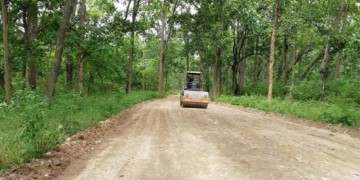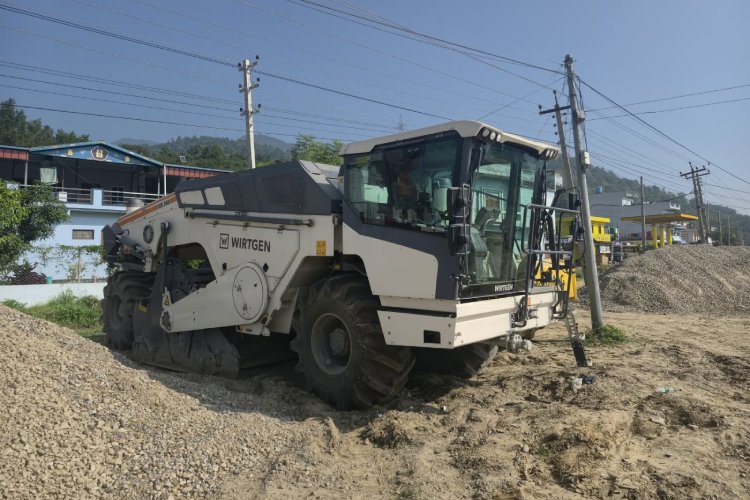
KATHMANDU:Nepal is set to use Full Depth Reclamation (FDR) technology for road construction for the first time. The equipment required for the process has arrived in Dang.
The technology will be used to upgrade and widen the Dhan Khola-Lamahi section of the East-West Highway under the US-funded Millennium Challenge Corporation (MCC) project.
The Millennium Challenge Account Nepal (MCA-Nepal) confirmed the arrival of the FDR machine in Dang.
FDR technology allows existing road materials, including old asphalt, to be reused in rebuilding roads. This makes road construction more cost-effective, durable and environmentally friendly. It can also make future road maintenance easier and more efficient.
Under the MCC project, a 77-kilometer section of the East-West Highway, from Bhalubang in Dang to Shikhola in Banke, is being upgraded. The first phase covers a 40-kilometer stretch from Dhan Khola to Lamahi.
Nepal’s Sharma-Kumar JV has secured the construction contract for this section at USD 20 million (approximately Rs 3.08 billion), excluding VAT. The contract was signed on December 22, 2025, and the project must be completed within two years.
The upgraded road will be 12 meters wide, with a seven-meter carriageway and 2.5-meter shoulders on each side.
FDR and Superpave are two complementary technologies used in modern road construction. They have been in use in the United States and European countries since the 1980s and are now also being adopted in Asian and African countries.
FDR forms the lower layer of the road. Depending on the road design, this layer is generally 250 to 300 mm thick. It is made by mixing recycled road materials with cement, lime or bitumen to create a strong base capable of carrying heavy loads.
Superpave is used for the upper asphalt layer. Unlike conventional asphalt mixes, it uses high-quality Performance Grade (PG) bitumen to improve road strength, safety and durability.
Under the FDR process, existing road materials such as gravel and old asphalt are broken down using a pulverizing machine. The processed materials are then mixed with cement and reused in the lower road layer.
FDR technology can reduce the cost of upgrading existing roads by up to 30 percent compared to conventional DBM-based methods, while also reducing the need for new construction materials.