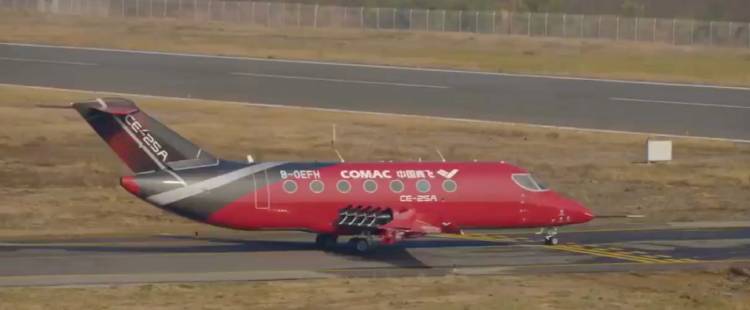
KATHMANDU: China has taken another step towards electric aviation after the Commercial Aircraft Corporation of China (COMAC) successfully completed the first crewed flight of its CE-25A battery-electric commuter aircraft.
The 19-seat aircraft completed the flight on Saturday in Binzhou, Shandong province, with two pilots and a flight test engineer on board. The aircraft weighs around 10 tons, and COMAC reported that all systems operated normally during the test.
The crewed flight followed 19 autonomous test flights conducted since February 2. China’s aviation regulator has also begun reviewing the aircraft’s type certificate application, marking the start of its airworthiness certification process.
19 seats and 400 km range
The CE-25A features a T-tail design and 10 electric ducted fans mounted on its wings, with five on each side, instead of conventional propellers.
According to COMAC, the aircraft has a cruising speed of 300 km/h and a claimed range of up to 400 km.
The aircraft was first displayed as a model at the China International Import Expo in Shanghai in November 2023. However, the full-size aircraft, registered as B-0EFH, became publicly known only in October 2026 after photographs appeared on Chinese social media.
Despite the successful test flight, commercial operations are still some distance away. The certification review does not mean the aircraft is ready to carry paying passengers, and COMAC has not announced a commercial service date.
CATL connection raises battery expectations
The battery technology used in the CE-25A has not been officially disclosed. However, CATL is considered a potential battery supplier because of its earlier partnership with COMAC and Shanghai Jiao Tong University, according to media reports.
In July 2023, the three organizations established a joint venture with registered capital of USD 83 million to develop electric aircraft technology.
Around the same time, CATL introduced its condensed battery technology, claiming an energy density of up to 500 Wh/kg at the cell level. The company also said it was testing the technology to meet aviation standards.
Battery energy density of around 500 Wh/kg has long been considered an important target for making commercial electric aviation more practical.
COMAC is not the only company developing large battery-electric aircraft.
US-based Heart Aerospace completed a 27-minute test flight of its X1 demonstrator in Plattsburgh, New York, in August 2026. The company described it as the largest battery-electric aircraft to have flown, with a weight of around 11.34 tonnes and a wingspan of 106 feet.
Meanwhile, Eviation’s nine-seat Alice aircraft completed its first flight in September 2022, but the company laid off most of its employees in early 2025.
Heart Aerospace previously developed the 19-seat ES-19 before shifting its focus to the 30-seat ES-30 in 2022. The newer aircraft uses reserve turbogenerators to extend its range, while BAE Systems is working on its battery technology. Heart is targeting commercial operations by 2031 and claims the aircraft could reduce operating costs by more than 40%.
COMAC’s CE-25A represents another major development in the effort to bring battery-powered aircraft into commercial aviation. However, certification, battery performance and operating economics will determine how quickly such aircraft can enter regular passenger service.