KATHMANDU: GAC Aion is set to launch its new electric sedan, the Ray 7, in China on November 12, 2026. The model, which opened for pre-orders is available in five variants, with pre-sale prices ranging from USD 19,200 to USD 23,700.
The Ray 7 has been described as a half-priced alternative to the Xiaomi SU7, targeting buyers looking for a sporty electric sedan with advanced technology and a long driving range.
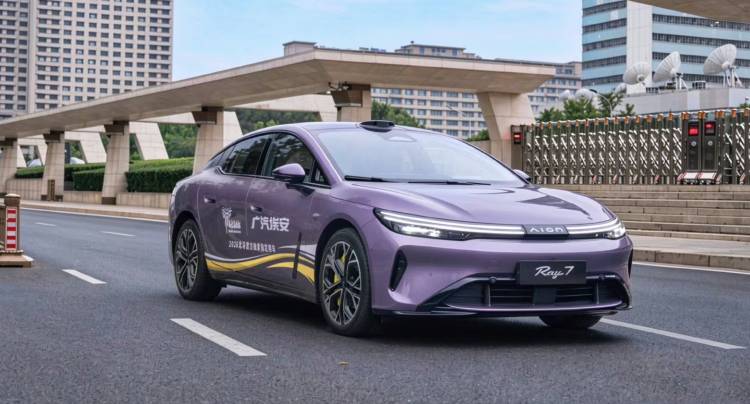
The Aion Ray 7 features a fastback-style design with a low-slung profile. Its front fascia gets a full-width light bar, illuminated brand logo and large air intakes integrated into the lower bumper. The design follows GAC’s new ‘Quantum Star Ring’ styling language.
The sedan measures 4,960 mm in length, 1,900 mm in width and 1,455 mm in height, with a wheelbase of 2,920 mm. It also features semi-hidden door handles, dual five-spoke alloy wheels and yellow brake calipers.

At the rear, the car gets a full-width LED tail-light arrangement with AION branding. The company claims a drag coefficient of 0.22, indicating its focus on aerodynamic efficiency.
One of the major highlights of the Ray 7 is its advanced driver assistance system. It comes equipped with 27 automotive-grade sensors, including a Huawei 192-line LiDAR and three 4D millimeter-wave radars.
The system uses technology derived from WeRide’s Level 4 autonomous Robotaxi platform. It is designed to support driving assistance in complex urban environments, along with automated parking and gate navigation.
Inside, the sedan features a digital instrument cluster and a large floating central touchscreen. Other equipment includes a multifunction three-spoke steering wheel, integrated sports seats, wireless smartphone charging and dual cup holders.

The GAC Aion Ray 7 uses a ‘Super Electric’ powertrain that combines Huawei’s DriveONE integrated electric drive system with GAC’s 28-in-1 thermal management module.
The company claims an energy consumption figure of 9.7 kWh per 100 km under the CLTC testing cycle.
The sedan is offered with two battery and range options. The standard version uses GAC’s Inpow lithium iron phosphate (LFP) battery and offers a claimed range of 530 km. The long-range version gets a CATL-supplied LFP battery with a claimed range of 702 km under the CLTC cycle.
These figures are equivalent to approximately 429 km and 569 km, respectively, under the WLTP testing cycle.