KATHMANDU: BYD’s vehicle sales in Nepal have continued to grow every year, but its share of the EV market has been declining over the past two years.
The Chinese automaker has increased its annual sales by around 20 times in five years. However, its overall market share has dropped by six percentage points during the same period.
BYD entered Nepal in 2017 and has been selling more than 2,000 units annually since 2023. Its sales crossed 4,000 units in the first 10.5 months of 2026. Despite the growth, its market share has fallen to 27.1 percent from a peak of 32.8 percent in 2024.
In 2020, BYD held just 5.8 percent of Nepal’s passenger EV market, when annual EV sales in the country were around 100 units. The market began expanding rapidly in 2021. Annual passenger EV sales have now reached around 15,000 units.
As the market expanded, BYD’s share increased to 32.8 percent in 2024. However, it declined to 29.3 percent in 2025 and further to 27.1 percent in 2026, even as the company continued to increase its sales volume.
Why is BYD losing market share?
The decline does not necessarily indicate weak sales performance. Instead, growing competition, more brand choices and aggressive pricing by new EV makers have put pressure on BYD’s market position.
Several new brands have entered Nepal with competitively priced EVs featuring modern technology and advanced features. This has given customers more alternatives beyond BYD models.

BYD has also faced pressure from a limited number of new model introductions. The company has brought only a few new models to the market over the past year, while more than a dozen competing models have entered Nepal during the same period.
Brands such as Tata, Dongfeng, Chery, Changan and Proton are gradually expanding their presence. Their growing market share has reduced BYD’s overall share. More than three dozen EV brands are now available in Nepal.
BYD’s annual sales growth
Although BYD has been present in Nepal for nine years, its significant sales growth began only in the last four years. The company has sold more than 13,500 EVs in the country over the past seven years, with around 13,300 units sold in the last 46 months alone.
Cimex Inc., the authorized distributor of BYD in Nepal, first introduced the electric MPV E6 in March 2017. The company initially imported five units of the model.
BYD imported 15 units in 2020, 71 in 2021 and 192 in 2022. Its sales gained momentum after the company started selling passenger cars in October 2022.
Annual sales reached 2,178 units in 2023, followed by 3,536 units in 2024 and 3,540 units in 2025. The company sold 4,063 units between January 1 and November 15, 2026.

Along with sales, BYD has focused on expanding its dealer network, service facilities and charging infrastructure. These efforts have helped strengthen customer confidence and support its business growth.
The company currently has more than 15 showrooms and service centers across Nepal, along with over 60 charging stations.
Nine models currently available
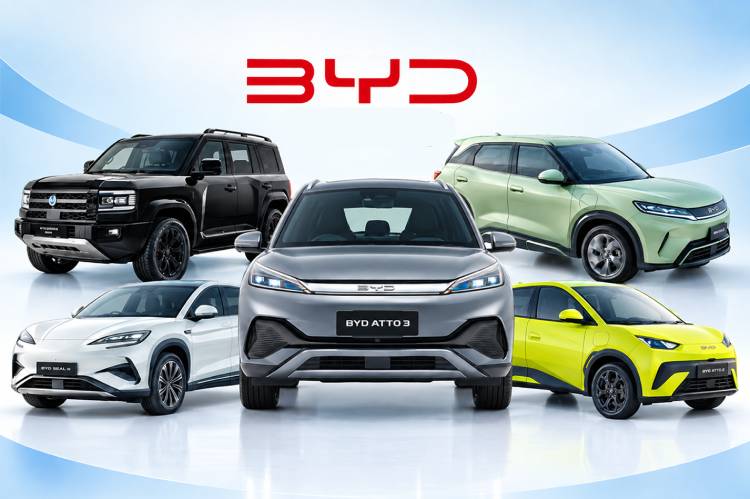
Cimex Inc. Currently sells nine BYD models in Nepal, ranging from entry-level hatchbacks to luxury SUVs. Their prices start at around Rs 31 lakh and go up to nearly Rs 4 crore.
BYD has introduced 11 models in Nepal across the MPV, SUV, sedan and pickup segments. Apart from the Dolphin and E6, the other models have remained part of its Nepal lineup.
The current range includes the M6, Atto 3, Atto 2, Atto 1, Sealion 7, Denza D9, B5, B8, Seal and Shark, along with the M6 listed in the company’s lineup.