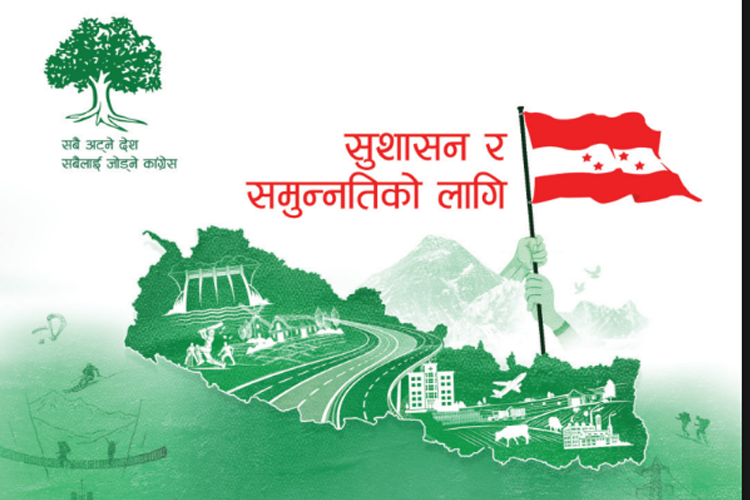
KATHMANDU: The Nepali Congress has unveiled its election manifesto for the upcoming House of Representatives election scheduled for March 5, outlining 45 key commitments in the transport and infrastructure sector. The party presented its “Commitment Letter” at Rastriya Sabha Griha in Kathmandu.
Below are the 45 major transport and infrastructure agendas highlighted in the manifesto:
- Expand strategic infrastructure, including roads, to reduce freight costs and lower market prices.
- Discourage syndicates, monopolies and artificial price-setting in the freight sector, ensure open competition, and streamline collection systems to reduce costs for small entrepreneurs.
- Prioritize electric vehicles and green energy in public transport and achieve net-zero emissions by 2045; Utilize carbon trade benefits to directly improve local communities.
- Introduce a Multimodal Transport Act to integrate road, rail and air services under a single framework and make trade infrastructure climate-resilient and disaster-resistant.
- Select projects based on national priorities and ensure resource availability, strengthen inter-agency coordination, and remove implementation bottlenecks to complete projects on time.
- Reform the contract system by simplifying procurement laws and improving bid evaluation to prioritize technical capacity, experience and credibility.
- Amend the Public Procurement Act to move beyond lowest-bid practices and implement evaluation based on technical, financial and performance criteria.
- Fully digitize the tender process, institutionalize transparency and monitoring, improve design and cost estimation quality, clarify risk-sharing, ensure fast dispute resolution and apply objective blacklisting provisions.
- Ensure adequate infrastructure financing through multi-financial instruments, including an Infrastructure Development Bank, project-specific bonds and public-private partnerships, with legal provisions for project-based financing.
- Build accident-free, all-weather roads connecting local government centers, integrating environmental sustainability, lighting and modern technology.
- Upgrade highways nationwide to operate year-round, preventing disruptions during normal rainfall.
- Mandate footpaths, skywalks, disability-friendly bus stops and environmentally sustainable features in road design and construction.
- Upgrade at least one key road connecting Kathmandu to Hetauda within one year to ensure uninterrupted access.
- Prioritize construction and upgrading of roads linking provincial capitals to local government centers, wards and markets.
- Prioritize regular maintenance of existing road networks and link rural roads to livelihood opportunities.
- Allow income-generating activities at designated road corridor locations to promote community ownership.
- Reduce accidents by prioritizing safety in road design, upgrading standards, replacing risky crossings and suspension bridges, and lowering transport costs.
- Develop vehicle inspection and driver monitoring systems and adopt climate-friendly road construction technologies for long-term sustainability.
- Expand the East-West Highway to four lanes across all sections and facilitate completion of the Kathmandu-Terai Fast Track.
- Accelerate reconstruction of BP Highway and complete remaining blacktopping of Kanti Lokpath within one year to ensure a permanent alternative route to Kathmandu.
- Complete Madan Bhandari Highway and all north-south corridors, prioritize tunnel construction and complete the Siddhababa Tunnel project.
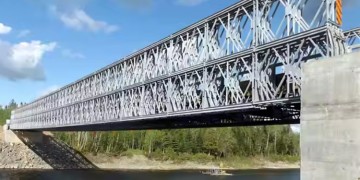
- Introduce advanced bridge and tunnel technologies to shorten travel distances and develop river embankments as alternative road corridors where feasible.
- Develop a National Road Information System app to provide real-time updates on traffic, accidents, disasters, road closures and reopening schedules.
- Launch a “Bright Roads” campaign by installing and maintaining solar street lights nationwide with private sector participation.
- Amend transport laws and establish a powerful Transport Authority with coordinated structures to modernize services.
- Issue route permits based on road condition and geography, allowing appropriate vehicle types for a systematic transport system.
- Implement technology-based traffic management, alternative route utilization and junction improvements in urban areas and major highways.
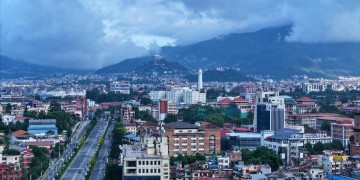
- Use smart traffic lights and surveillance cameras in Kathmandu Valley, provincial capitals and major cities to manage traffic efficiently.
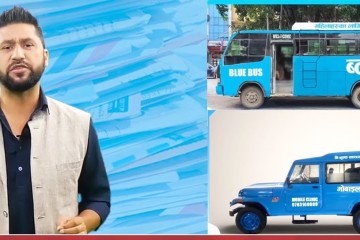
- Ensure that new public transport vehicles operating in Kathmandu Valley are electric.
- Introduce a smart transit system within one year featuring high-capacity vehicles, queue systems, improved routes, integrated ticketing and distance-based fare sharing.
- Focus all state efforts on reducing road accidents, recognizing them as a major national concern.
- Conduct impartial studies of road accidents and strengthen institutions with resources and legal authority to enforce reforms.
- Promote civic awareness and driver literacy to improve responsible road use.
- Establish an empowered Transport Authority representing stakeholders to formalize and regulate the largely informal transport sector.
- Bring public transport workers into the Social Security Fund to formalize employment.
- Improve long-distance public transport by upgrading bus parks, stops and technology-based monitoring systems, and enforce quality standards in rest and food facilities.
- Reduce reliance on motorized vehicles by prioritizing non-motorized transport and sustainable urban mobility plans in municipalities.
- Promote reduced travel demand, energy-efficient transport modes and improved mobility management.
- Mandate greenery and cycle racks in new urban developments and road expansions.
- Ensure footpaths, cycle tracks and greenery in all categories of urban roads, promoting human-centered street design.
- Resolve land compensation issues and advance construction of cross-border and East-West railways connecting Kathmandu; conduct feasibility study for Kathmandu-Pokhara-Lumbini electric railway.
- Invest in infrastructure and facilitate operations in areas with potential for water transport.
- Expand road connectivity in Karnali Province through strategic corridors including Jamunaha-Kohalpur-Surkhet-Hilsa Fast Track and other regional routes.
- Construct the Surkhet-Kohalpur tunnel road to reduce travel time and improve economic and service connectivity in Karnali.
- Implement multiple strategic road projects in Sudurpaschim Province to strengthen geographic integration, service access and economic activity across remote districts.