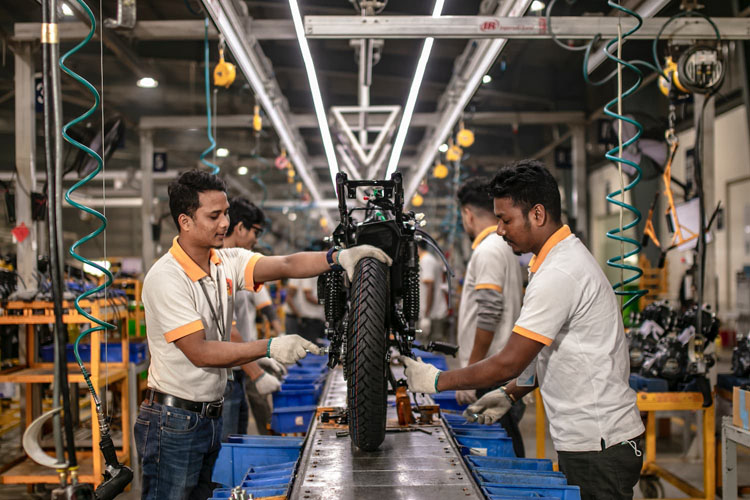
KATHMANDU: Two-wheeler assembly industries operating in Nepal have failed to add meaningful value even years after starting operations, despite receiving government incentives such as tax exemptions. Most assembly plants have also not complied with the conditions set by the government.
In November 2021, the Department of Industry introduced four key conditions for motorcycle assembly industries. These included at least 10 percent value addition in the first year and 30 percent within five years, employment for a minimum of 50 people in the first year and 200 within five years, and the use of at least 10 percent domestically produced goods in assembled vehicles.
According to these provisions, assembly plants should currently be using at least 10 percent Nepali-made products. However, most are still relying on imported engine oil, tires, batteries, and spare parts, even though such products are available in Nepal.
Industry observers say that assembly companies have not invested in ancillary industries nor shown interest in using locally produced components. As a result, the government’s plan to gradually move from basic assembly to a full-fledged manufacturing ecosystem has stalled.
So far, value addition has largely been limited to electricity use and labor employment. No concrete progress has been seen in backward integration or local component sourcing.
The demand for mid-size motorcycles has increased steadily over the past five years, especially in the 250cc to 400cc segment. Government tax concessions on Nepal-assembled two-wheelers have been a key driver of this growth. As a result, almost all major two-wheeler brands operating in Nepal have started assembly operations.
Bajaj was the first company to start motorcycle assembly in Nepal. It was followed by TVS, Yamaha, Honda, Hero, Suzuki, CF Moto, and others.
Meanwhile, production of motorcycle parts and components has started domestically, with manufacturers claiming that high-quality products are now being made in Nepal. However, local producers say assembly companies have shown little interest in using them.
Dipendra Mishra, producer of Veedol lubricants, said Nepali industries are capable of supplying engine oil, batteries, tires, and other components. “The capacity exists, but the motorcycle assembly industry has to be willing to use these products,” he said.
Mishra has invested through United Lubricants Industries Pvt. Ltd., which operates a plant in Lalbhitti, Mithila Municipality-3, Dhanusha. The company produces Veedol-brand lubricants and greases.
“Veedol produces synthetic and semi-synthetic engine oils used in everything from commuter motorcycles to performance bikes. Despite the quality, the assembly industry is not interested in using them,” Mishra told MeroAuto.
The company currently manufactures engine oils, greases, and batteries and is preparing to start producing motorcycle brake components. Mishra said the total investment has reached Rs 500 million.
“If assembly companies used our products, many small industries would emerge. The government has also failed to implement the rules it has made itself,” he said.
While assembly industries have not met the required conditions, the government has also failed to effectively monitor and evaluate compliance. Despite offering incentives to encourage industrial growth, tangible outcomes from the policy remain limited.