KATHMANDU: Car prices are coming under pressure in global markets as automakers face higher costs for raw materials, energy and transportation.
The industry is also facing continued semiconductor supply challenges. These factors could push vehicle prices higher in the coming months.
The ongoing conflict in Iran has increased oil and energy prices. This has raised costs across the automotive supply chain, from manufacturing to transportation. Prices of plastic, aluminum, steel, copper and electronic chips have also gone up.
Automakers are also under pressure to move parts of their supply chains away from low-cost markets such as China and Mexico. Rising trade restrictions are adding further costs and making global supply chains more difficult to manage.
French automaker Renault expects more than $464 million in additional costs in the second half of this year because of higher raw material prices and inflation.
Renault CFO Duncan Minto said the rise in raw material prices appears to be becoming a longer-term trend rather than a temporary increase.
Stellantis is also expecting around $1.16 billion in additional costs in the second half of the year. The company has indicated that higher raw material costs could lead to higher vehicle prices in North America.
The growing demand for memory chips is creating another challenge for automakers.
The rapid growth of AI-powered data centers has pushed up the demand for memory chips. Technology companies are also willing to pay more for chips, making it harder for automakers to secure supplies at competitive prices.
Toyota expects around $8.12 billion in additional costs during the current financial year. The increase is linked to higher raw material prices and spending to strengthen its supply chain.
The company plans to recover around half of these additional costs through vehicle price adjustments.
The problems are also spreading to automotive suppliers. Financial difficulties among some suppliers could create further disruptions and affect both vehicle production and availability.
The current situation is not being driven by one problem alone. War, higher raw material prices, chip shortages, trade restrictions and supply chain disruptions are all adding pressure at the same time.
As costs rise, automakers are likely to pass at least part of the increase on to consumers.
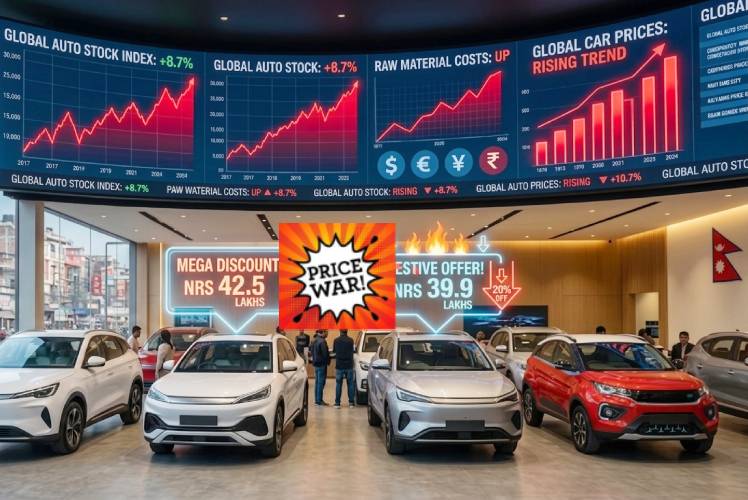
While global automakers are preparing for higher costs and prices, Nepal’s auto market is moving in the opposite direction.
A price war is becoming more visible, especially in the electric vehicle market. When one company launches a new model at a competitive price, other brands face pressure to offer similar or even lower prices.
Nepal’s growing dependence on vehicles imported from China has also increased competition among distributors. Companies are competing on price, features and sales to attract customers.
As a result, Nepali buyers are getting more choices, better features and increasingly competitive prices.
But a lower purchase price does not always mean lower ownership costs.
Spare parts for some newer brands and models can still be expensive. This means customers may save money when buying a new vehicle but could face higher costs when repairing or maintaining it.
Nepal’s current price war is good news for new-car buyers in the short term. However, after-sales service, spare parts availability and long-term ownership costs will remain important when choosing a vehicle.