KATHMANDU: Nepal Rastra Bank (NRB) has continued its flexible monetary policy for the fiscal year 2026/27, aiming to support economic growth and improve financial stability.
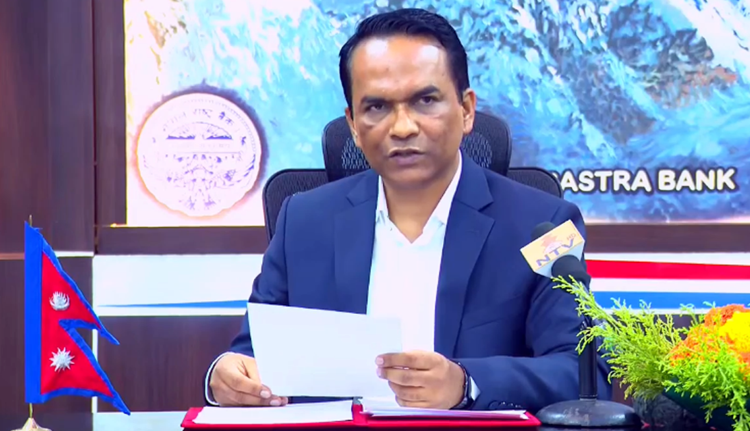
Governor Bishwo Nath Poudel announced the new monetary policy on Tuesday. He said the central bank has retained its flexible policy stance to support the country’s economic recovery and growth.
The central bank has kept key policy rates under the interest rate corridor unchanged. These include the policy rate, standing deposit facility rate, and bank rate. It has also retained the existing provisions on the Cash Reserve Ratio (CRR), Statutory Liquidity Ratio (SLR), and Standing Liquidity Facility (SLF).
NRB has also announced several policy changes. These include removing unlimited liability created by personal guarantees for loans, reducing the chances of borrowers being blacklisted due to bounced checks, managing non-performing loans in sick industries, supporting the revival of stressed loans, easing loan-to-value (LTV) rules for share-backed loans based on an institution’s strength, and relaxing LTV limits for large electric vehicles used as public transport.
For the upcoming fiscal year, NRB has set a target of 11 percent growth in private sector lending. It has also projected broad money supply growth of 14 percent and inflation at 5.5 percent.
The eight major provisions announced in the monetary policy are:
- NRB will continue using macroprudential regulatory tools when systemic risks emerge in any sector of the economy, recognizing that monetary policy alone may not be enough to address such risks.
- The central bank will work to improve monetary policy transmission by reforming the financial sector, strengthening branch management, expanding digitalization, reducing financial costs, and ensuring those savings are passed on to customers through better-quality services.
- After completing the ongoing study on the classification of banks and financial institutions, NRB will gradually introduce new regulatory measures to encourage banks, financial institutions, and non-bank financial institutions to expand services within their designated areas of operation.
- Special policy measures will be introduced to remove unlimited liability from personal guarantees, reduce blacklisting caused by bounced checks, manage non-performing loans in sick industries, revive stressed loans, determine share-backed loan limits based on institutional strength, and ease loan-to-value requirements for large electric vehicles used as public transport.
- NRB will simplify regulatory directives issued to banks and financial institutions by removing complex language and overlapping provisions. In the first phase, directives related to lending, interest rates, and customer protection will be rewritten.
- Existing foreign exchange regulations will be simplified. The integrated circular issued to institutions authorized to conduct foreign exchange transactions will also be revised to make compliance easier.
- The central bank will study the possibility of introducing peer-to-peer (P2P) lending based on an individual credit scoring system.
- NRB will gradually implement programs related to the bank that are included in the Government of Nepal’s national commitments, governance reform agenda, 100-point action plan, and the national budget, in coordination with the concerned agencies.