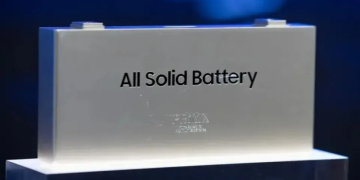
KATHMANDU: Chinese researchers have reported a major advance in solid-state battery technology with the development of a new “breathable” silicon anode.
The study was led by Professor Chen Wanghua of Ningbo University, in collaboration with Ningbo University of Technology and Ningbo Institute of Technology according to Global Times.
The team developed a three-dimensional silicon nanowire anode using plasma-enhanced chemical vapor deposition (PECVD). The structure features a columnar, core-shell design that allows silicon to expand during charging without damaging the solid electrolyte. The research was published in Energy Storage Materials.
Silicon is considered a key anode material for next-generation all-solid-state lithium batteries due to its theoretical capacity, which is about ten times higher than graphite. However, silicon typically expands more than three times during charge-discharge cycles, causing mechanical failure and rapid performance loss.
The newly designed nanowire structure creates internal voids that absorb volume expansion, maintaining mechanical stability and interface integrity. According to the researchers, the anode demonstrated strong electrochemical performance and continued operation even when bent or cut, indicating high safety and durability.
The breakthrough offers a practical pathway towards high-energy-density, long-life solid-state lithium batteries and could accelerate the commercialization of silicon-based solid-state battery systems.