KATHMANDU: Electric vehicles are gradually becoming more common in Nepal. Most discussions focus on how many EVs are on the road. But numbers alone do not tell the full story.
A more important question is how efficiently these vehicles are being used. In this context, thinking in terms of passenger-km per kWh can be practical and forward-looking when setting EV priorities.
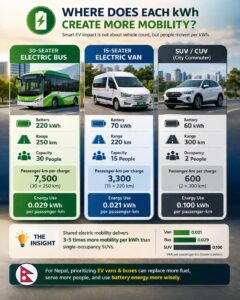
Simple comparisons make this clear. A 30-seater electric bus with a 220 kWh battery can travel about 250 km. If fully occupied, it can carry people for around 7,500 passenger-km on a single charge.
A 15-seater electric van with a 70 kWh battery can travel around 220 km. It delivers about 3,300 passenger-km.
Now compare that with a typical electric SUV. It may have a 60 kWh battery and a range of 300 km. But with only two people on average, it produces about 600 passenger-km.
The difference now visible
Vehicles that carry more people make better use of energy. Buses, vans, and shared transport can move more passengers using the same electricity. Private EVs often use more energy per person.
This matters for Nepal. The country still depends on imports for energy and transportation. At the same time, building EV infrastructure requires investment.
Using energy wisely can help reduce costs and pressure on resources.
This is why shared electric transport is important. Public buses, school vehicles, office shuttles, and tourist transport can make EV use more efficient.
The goal should not be just adding more EVs. It should be using them better.
For Nepal, the shift to electric mobility is not only about cleaner transport. It is also about moving more people with less energy.
(The details in this report are based on a Facebook post shared by Deepak Thapaliya.)