KATHMANDU: A new transport master plan has proposed the construction of 8.44 km of elevated highways at three of Kathmandu Valley’s busiest traffic corridors to address chronic congestion and improve traffic flow.
The proposal is included in the Kathmandu Valley Urban Transport System Master Plan, jointly prepared by the Ministry of Physical Infrastructure and Transport and the Japan International Cooperation Agency (JICA).
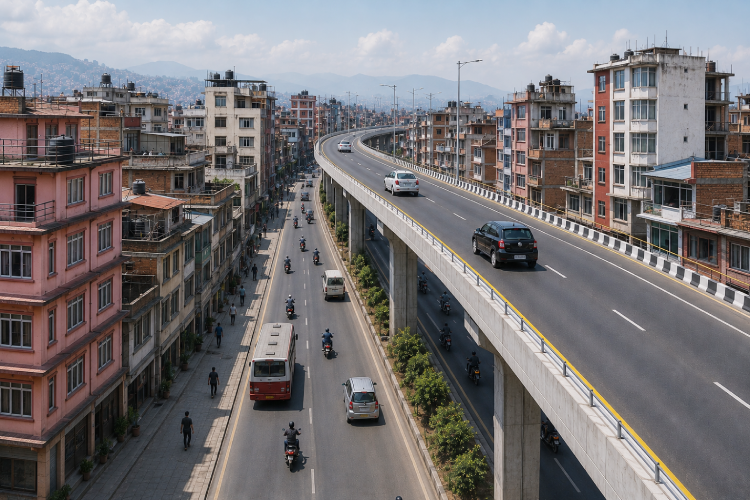
According to the plan, elevated highways have been proposed along the Maitighar-Thapathali-Tripureshwor, Chabahil-Bagmati River and Bishnumati Corridor sections. These routes experience heavy traffic, while limited land availability makes conventional road widening difficult.
The study estimates the combined cost of the three elevated highway projects at Rs 82 billion to Rs 111 billion, depending on the final design and alignment.
An elevated highway is a road built above ground level on reinforced concrete pillars. It is commonly used in urban areas where land is scarce and traffic congestion is severe. The design eliminates intersections, traffic lights and pedestrian crossings, allowing vehicles to move continuously at higher speeds. While elevated highways reduce the need for large-scale land acquisition, they require significantly higher construction costs and more complex engineering than conventional roads.
Maitighar–Tripureshwor
The master plan proposes a 1.422-km, two-lane elevated highway between Maitighar and Tripureshwor to improve traffic movement through the capital’s central business district.
The project is estimated to cost 13.9 billion Japanese yen (around Rs 13.47 billion), including about 60 million yen for land acquisition and compensation.
The report also recommends studying whether the highway’s supporting pillars could accommodate future railway infrastructure.
Chabahil–Bagmati river
A 3.4-km, two-lane elevated highway has been proposed between Chabahil Chowk and the Bagmati River. The plan also includes a one-way ramp at Jorpati Chowk towards Chabahil.
The project carries a preliminary cost estimate of 26 billion Japanese yen (around Rs 25.2 billion).
Since the proposed alignment passes near the Boudhanath Stupa, a UNESCO World Heritage Site, the report says a Heritage Impact Assessment (HIA) and archaeological studies must be completed before construction. If the current alignment is found unsuitable, an alternative route will have to be considered.
Bishnumati corridor
The master plan also recommends a 3.62-km, four-lane elevated highway along the Bishnumati Corridor to ease traffic in western and southern Kathmandu.
To minimize flood risks, the highway has been proposed at least 20 meters from the Bishnumati riverbank.
Three alignment options have been identified for the section extending from Balaju towards Tokha. The estimated cost ranges from 45 billion to 75 billion Japanese yen, or around Rs 43.5 billion to Rs 72.7 billion.
13 additional transport projects proposed
Beyond the elevated highway network, the master plan proposes 13 additional transport projects to modernize Kathmandu Valley’s transport system.
The proposals include road tunnels, underpasses, overpasses, modern bridges, underground parking facilities and new transport corridors. The combined estimated investment for these projects exceeds Rs 200 billion.
JICA and the Government of Nepal began preparing the master plan in 2024, and the report is now in its final stage. It is expected to be submitted to the government later this month.
JICA previously prepared urban transport master plans for Kathmandu Valley in 1991 and 2007, but neither was implemented. This time, the agency has recommended that the master plan receive Cabinet approval to improve the likelihood of implementation.