KATHMANDU: The Ujyalo Nepal Party has made public its election manifesto, focusing on good governance, social justice, economic growth, and constitutional amendment. Party Chair Kulman Ghising unveiled the document at a program held in Kathmandu on Sunday.
The party has outlined priority sectors including the economy, employment, energy, tourism, health, education, industry, and trade. It aims to mobilize domestic capital by expanding cooperation among the private sector, cooperatives, and local communities, while attracting foreign investment in priority areas.
The manifesto sets targets to increase Nepal’s GDP to USD 70 billion by 2030 and USD 111 billion by 2035, transform the country into an upper middle-income nation by 2035, expand exports to USD 10 billion by 2030 and USD 20 billion by 2035, and generate around one million additional jobs annually. The party has also pledged to create 4.5 million jobs within the next five years.
In the energy sector, the party plans to increase hydropower generation to 12,000 MW by 2030 and 25,000 MW by 2035, with expanded electricity exports to India, Bangladesh, and China. Hydropower, herbs, cement, tourism, and IT have been identified as priority industries.
The manifesto also proposes structural reforms, including reducing the number of House of Representatives members from 275 to 201 and Provincial Assembly members from 550 to 330. It suggests directly electing chief ministers to ensure provincial stability. The federal cabinet would be limited to 15 members and provincial cabinets to a maximum of seven members.
Seven agendas on roads and infrastructure
Under its infrastructure plan, the party has presented seven key commitments:
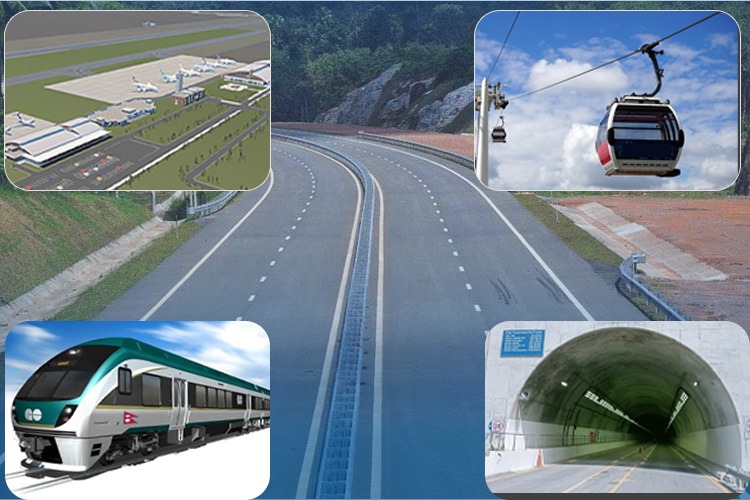
- Road upgrading and expansion: Within five years, the party plans to blacktop 8,000 km of roads, gravel 4,000 km, and open 3,000 km of new tracks. Major corridors including the Kathmandu-Nijgadh route, East-West Highway, Mid-Hill Highway, Hulaki Highway, Koshi and Kaligandaki corridors, Seti Lokmarg, and Karnali Corridor will be upgraded and expanded.
- Railway development: A detailed study and investment modality will be finalized for the Raxaul-Kathmandu-Kerung railway and the proposed East-West railway to improve short-distance travel connectivity.
- Water transport: Feasibility studies will be completed for water transport in the Koshi, Gandaki, and Karnali river basins, followed by operation in viable sections. Necessary policies and laws for water transport will also be introduced.
- Maintenance and management: To ensure safer and smoother travel, rapid maintenance of major highways and urban roads will be prioritized. Road ambulance services will be arranged in all provinces for emergency response.
- Technology-based infrastructure: The party plans to study the feasibility of modern systems such as podways, tunnels, metro systems, and cable cars, and develop them under the Public-Private Partnership (PPP) model.
- Aviation and highway modernization: Operations at Pokhara International Airport and Gautam Buddha International Airport will be expanded by encouraging new airlines to enhance air connectivity. The investment modality for the proposed Nijgadh International Airport will be finalized and construction accelerated. National highways will be upgraded, north-south corridors completed, and rural roads gradually blacktopped.
- One province, one smart city: Under the National Planning Commission’s Smart City Framework Vision 2040, the party plans to move forward with studies to fully operate 13 smart cities, including Lumbini, Nijgadh, and Bharatpur. The initiative will integrate IoT systems, AI-based traffic management, real-time data monitoring, and climate-resilient regional development planning to ensure citizen-centered governance.