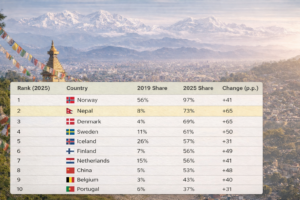
KATHMANDU: Nepal has become the world’s second-largest electric vehicle (EV) market by share, with 73 percent of new car sales in 2025 being electric, according to data compiled by Visual Capitalist based on analysis from Ember and the International Energy Agency.
Nepal now ranks just behind Norway, where EVs account for 97 percent of new car sales.
The latest figures show a sharp rise in Nepal’s EV adoption from just 8 percent in 2019 to 73 percent in 2025, marking one of the fastest growth rates globally. Nepal has also moved ahead of several advanced markets, including Denmark (69%), Sweden (61%), Iceland (57%), and Finland (56%). Major automobile markets such as Germany (29%), the United Kingdom (33%), and the United States (10%) remain well below Nepal in terms of market share.
Several factors have supported this rapid transition. Government policies offering tax benefits and reduced customs duties on EVs have made electric models more affordable than petrol and diesel vehicles.
As a country fully dependent on imported fuel, Nepal has also sought to reduce petroleum imports through electric mobility. In addition, the country’s strong hydropower generation base has provided relatively low-cost and clean electricity, making EV ownership economically practical.
Rising air pollution levels in Kathmandu Valley have further encouraged the shift towards electric transport.

Within South Asia, Nepal’s progress stands out. While Nepal has reached 73 percent, India remains at around 4 percent EV adoption. Other Asian markets such as Thailand (21%), Indonesia (15%), and Malaysia (4%) show moderate to low penetration. China, which leads in overall EV sales volume globally, has achieved a 53 percent market share.
Despite strong growth, challenges remain. Charging infrastructure expansion has not fully kept pace with rising EV sales, especially outside major cities. Concerns over grid capacity, limited model choices, and the need to strengthen after-sales service networks are also key issues for the sector.

In addition, the availability of skilled manpower in the EV service sector remains limited, and easy access to spare parts is still developing, which could affect long-term customer confidence and maintenance efficiency.
If the current growth trend continues, EV penetration could reach 80 to 85 percent by 2026. The country’s experience highlights how supportive policies, clean energy resources, and economic necessity can accelerate electric mobility adoption, even in developing markets.