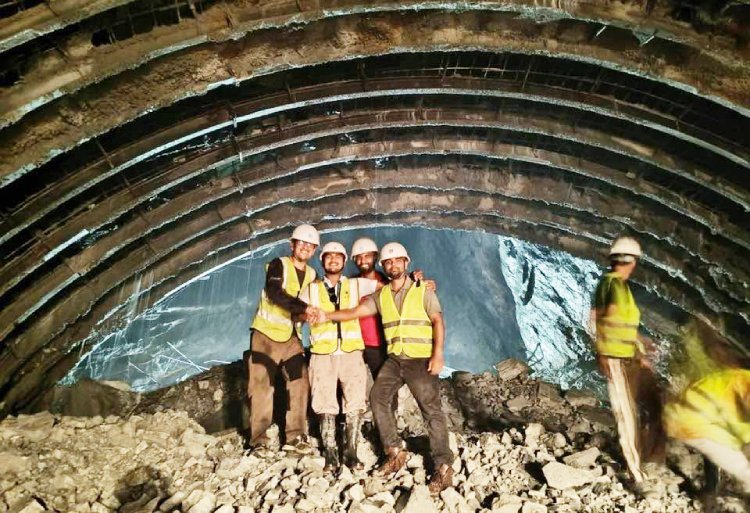
KATHMANDU: The Kathmandu-Terai/Madhesh Fast Track has achieved a major milestone with the breakthrough of the Mahadevtar tunnel.
The 3.486-kilometer left tube of the Mahadevtar tunnel has been successfully excavated. The tunnel connects the Dhedre and Mahadevtar sections of the expressway in Makwanpur.
The tunnel is being constructed by China State Construction Engineering Corporation (CSCEC). Engineer Mangal Lal Shrestha, who is associated with the project, confirmed the breakthrough through a social media post.
It makes Mahadevtar the longest tunnel on the Fast Track to achieve a breakthrough.
The other tube of the Mahadevtar tunnel is also progressing. The right tube is 3.422 kilometers long, and more than 3 kilometers has already been excavated, according to the latest project information.
Lining work is also being carried out alongside excavation. More than half of the lining work has been completed in the left tube, while more than one-third has been completed in the right tube.
The contract for the Mahadevtar tunnel was awarded to China State Construction Engineering Corporation for Rs 21.61 billion.
The Kathmandu-Terai/Madhesh Fast Track is 70.977 kilometers long. The project includes seven twin-tube tunnels with a combined tunnel length of about 11.21 kilometers when both directions are counted.
Separate tunnels are being built for traffic traveling between Kathmandu and Nijgadh in both directions. The Dhedre and Lendanda tunnels have already achieved breakthroughs. Finishing and lining works are continuing at these tunnels.
The Dhedre tunnel achieved its first breakthrough on May 24, 2024, when the 1.653-kilometer tube was completed. The other tube, measuring about 1.728 kilometers, achieved breakthrough on August 5, 2024.
At Lendanda, the 1.633-kilometer tube achieved breakthrough on May 17, 2024. The other tube, measuring about 1.612 kilometers, achieved breakthrough on July 4, 2024.
Secondary lining work has been completed at Lendanda, while work at Dhedre is in its final stage. Excavation is also continuing at the Chandram Bhir, Devichaur, Sisautar and Mauri Bhir tunnels.
Chandram Bhir is the second-longest tunnel section on the Fast Track. The project includes twin tubes of about 2.2 kilometers each. Secondary lining work has also started.
The Devichaur tunnel has twin tubes of about 1.075 kilometers and 1.1 kilometers. The Sisautar tunnel is the shortest tunnel section on the project. Its two tubes are about 560 meters and 480 meters long.
At Mauri Bhir, the two tubes are about 663 meters and 536 meters long. Devichaur and Mauri Bhir were awarded under the second phase of tunnel construction. Their progress is therefore lower than the tunnels awarded earlier.
The Fast Track was handed over to the Nepali Army in 2017 for construction. The project has been divided into 13 construction packages. Contracts have been awarded for 12 packages, while work on the Khokana-Dukuchhap section remains unresolved.
As of mid-July 2026, the project had achieved 48.72% physical progress. Financial progress, including mobilization costs, stood at 50.63%.
The project has an estimated cost of Rs 211.93 billion. It is currently targeted for completion by mid-April 2027, although officials have warned that the deadline could be difficult to meet because of the unresolved Khokana section.
The Fast Track is expected to significantly reduce travel time between Kathmandu and the Terai once completed.