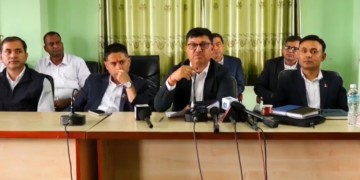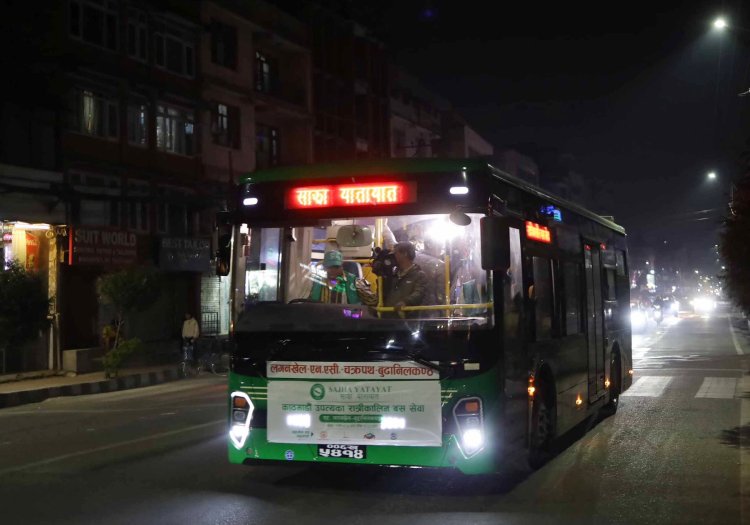
KATHMANDU: Kathmandu Metropolitan City (KMC) has proposed expanding night bus services to four additional routes in the Kathmandu Valley.
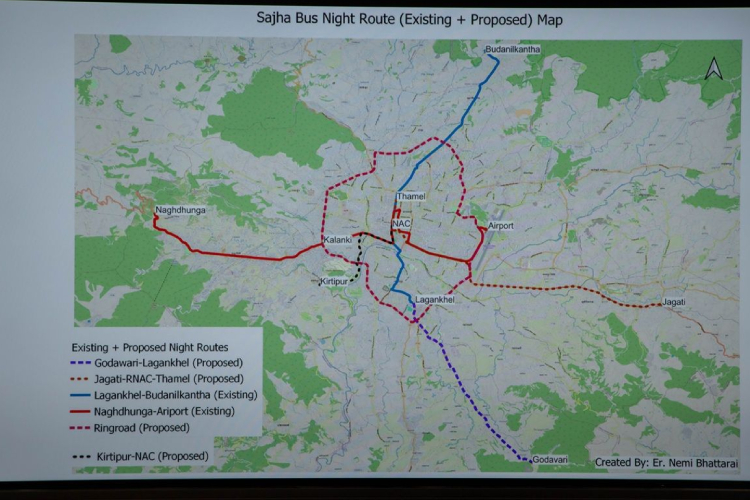
A task force formed by KMC to study the existing night bus service has recommended expanding the service to cover eight municipalities in the Valley. The service has been operating on the Nagdhunga-Airport and Lagankhel-Budhanilkantha routes since the first day of Nepali new year.
The proposed new routes are Godawari-Budhanilkantha, Ring Road in both directions, Jagati-Thamel, and Kirtipur-Nepal Airlines. These routes are planned to connect major hospitals, commercial areas, and key entry and exit points of the Valley.
Currently, seven buses operate on the two existing routes. The task force has recommended increasing the fleet to 28 buses after expanding the service.
Three options proposed to make night service sustainable
The task force has suggested three options to manage the higher operating costs of night services.
The first option is to introduce a night-time premium fare, adding Rs 12 to the existing fare. The additional amount would help cover higher costs such as staff allowances and technical expenses during night operations.
The second option is a viability gap funding model. Under this system, eight municipalities would jointly cover 50% of the total operating loss. The remaining 50% would be shared based on factors such as municipal size, population density, and operating distance.
The third option involves generating revenue through passenger-focused services, including real-time bus location and timetable information, along with programs aimed at improving passenger trust and confidence.
The report has also recommended giving priority to the safety of women, senior citizens, and tourists. It has suggested CCTV cameras inside buses, GPS tracking, and dedicated bus stops.
The task force believes greater participation from Suryabinayak, Madhyapur Thimi, Godawari, and Kirtipur municipalities could help strengthen the Valley’s nighttime economy and reduce dependence on private vehicles.
It has also suggested that the proposed Urban Area Public Transport Authority could be used to regulate and improve governance of public transportation in the federal capital.
66,952 passengers used the service in three months
The existing night bus service carried 66,952 passengers during its three-month trial period.
Each bus carried an average of 142 passengers per day and generated around Rs 3,134 in daily revenue. However, the average daily operating cost stood at Rs 4,814 per bus.
This resulted in an average daily loss of Rs 1,690 per bus, equivalent to around 35% of its operating cost.
The study found that passenger demand was highest between 8 PM and 9 PM, accounting for 41.56% of total passengers. Many of these passengers were employees returning late from work, workers, and daily wage earners.
By route, the Thankot-Airport route accounted for 51.55% of passengers, while the Budhanilkantha-Lagankhel route accounted for 48.45%.
Around 47% of passengers traveled less than 5 km, while 32% traveled medium distances and 21% traveled longer distances. The existing fares are Rs 20 for short-distance trips, Rs 25 for medium-distance trips, and Rs 30 for long-distance trips.