KATHMANDU: Laxmi Motor Hub, the automotive division of Laxmi Group, had planned to launch BAIC, Arcfox and Jetour at the NAIMA Mobility Expo. While BAIC and Arcfox were introduced, the launch of Jetour was postponed.
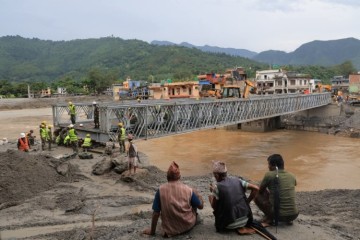
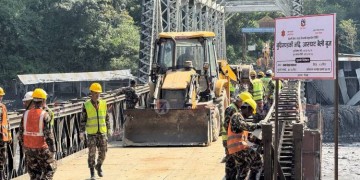
The Bhotekoshi flood on August 26 further disrupted the company’s plans, washing away vehicles that were on their way to Nepal and affecting the supply chain.
In this interview, Laxmi Motor Hub General Manager Deepak Thapaliya discusses customer response to the BAIC and Arcfox brands, the delayed Jetour launch, challenges in Nepal’s vehicle supply chain and the need to reconsider freight taxes on vehicle imports.
Both NAIMA and NADA auto shows have concluded. How was the customer response?
The initial response was very encouraging. We see auto shows as a kind of ice-breaking session. They bring automobile enthusiasts, potential customers, businesspeople, students, young people and those interested in new technology together before Dashain and Tihar.
There was strong interest in new vehicles, brands and technologies. Visitors spent time at different stalls, checked features and asked about prices and offers.
However, the unexpected Bhotekoshi incident has affected consumer sentiment. The market is not showing the same level of enthusiasm. The country’s overall economic and social situation has also played a role.
Customers do not necessarily book a vehicle at the auto show itself. Many visit, compare brands, understand financing options and then discuss the purchase with their families. The actual conversion usually becomes visible after a few days or weeks.
It has been more than a week since the auto show. How is the market now?
In previous years, auto shows were usually held around Teej. This year, they were held slightly earlier. Teej is generally seen as the beginning of the festive season. Nepali customers traditionally buy new vehicles during Dashain and Tihar.
However, the major disaster in the country has affected market activity. That is why the current market appears less active than expected.
You presented BAIC and Arcfox at the auto show. How was the response?
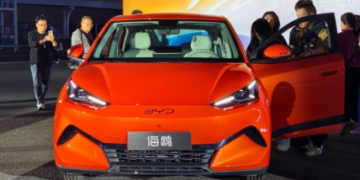
We received a very good response to BAIC. Vehicles with hybrid technology and off-road capability attracted a different group of customers.
There were limited options in the market around the Rs 10 million price range that combined lifestyle appeal, off-road capability, modern design and hybrid technology.
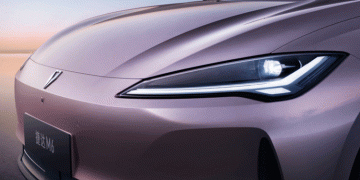
In that context, the BJ30 offered customers a new option. The response to Arcfox was even more encouraging. The design of the T1 immediately attracted attention.
The combination of design, size, interior space and features is one of its strengths. Customers also felt there was a good balance between the features and the price.
The modern design and spacious interior attracted many customers. The response was better than we had expected, and bookings followed accordingly.
Will the supply-chain disruption affect the delivery of booked vehicles?
We had vehicles ready. Some had already arrived in Nepal, while others were in transit. Unfortunately, the Bhotekoshi disaster has affected the supply chain. A large number of our vehicles were washed away by the flood.
We are making every possible effort from our side. We have also started exploring the option of bringing vehicles through the Korala border.
You had planned to launch Jetour at the auto show. What happened?
We had planned to launch Jetour at the auto show and had made the necessary preparations. However, some technical issues prevented the launch. Then, the August 26 flood washed away all the Jetour vehicles that were on their way to Nepal.
We will launch Jetour after some time. Our plan is to establish Jetour in the market differently from the usual approach. Jetour has developed a distinct identity in international markets as well.
There are already around 30 to 35 new brands in Nepal. Simply bringing vehicles into the market is not enough to establish a brand.
We need to ensure vehicle availability, spare parts, after-sales service, delivery capacity and a long-term business plan. We will therefore bring Jetour to the market with the right strategy.
What are the major challenges in Nepal’s vehicle supply chain?
One of the biggest problems Nepal is facing is supply-chain disruption. We often think that when a road or border point is closed, the impact is limited to a particular area or business. But in a modern economy, the impact spreads across the entire chain.
Clothing, food, construction materials, automobiles, electronics and daily consumer goods are all connected to the same supply chain.
A disruption in one place gradually affects other businesses. We see the same thing in the global economy. When a war breaks out in one country, oil prices rise and the impact is felt around the world. We are experiencing a similar situation now.
Nepal’s trade supply system also operates with limited capacity. Under normal conditions, there is a fixed cycle involving containers, trucks, warehouses and roads. Goods arrive from China, go through customs and reach Kathmandu or other markets.
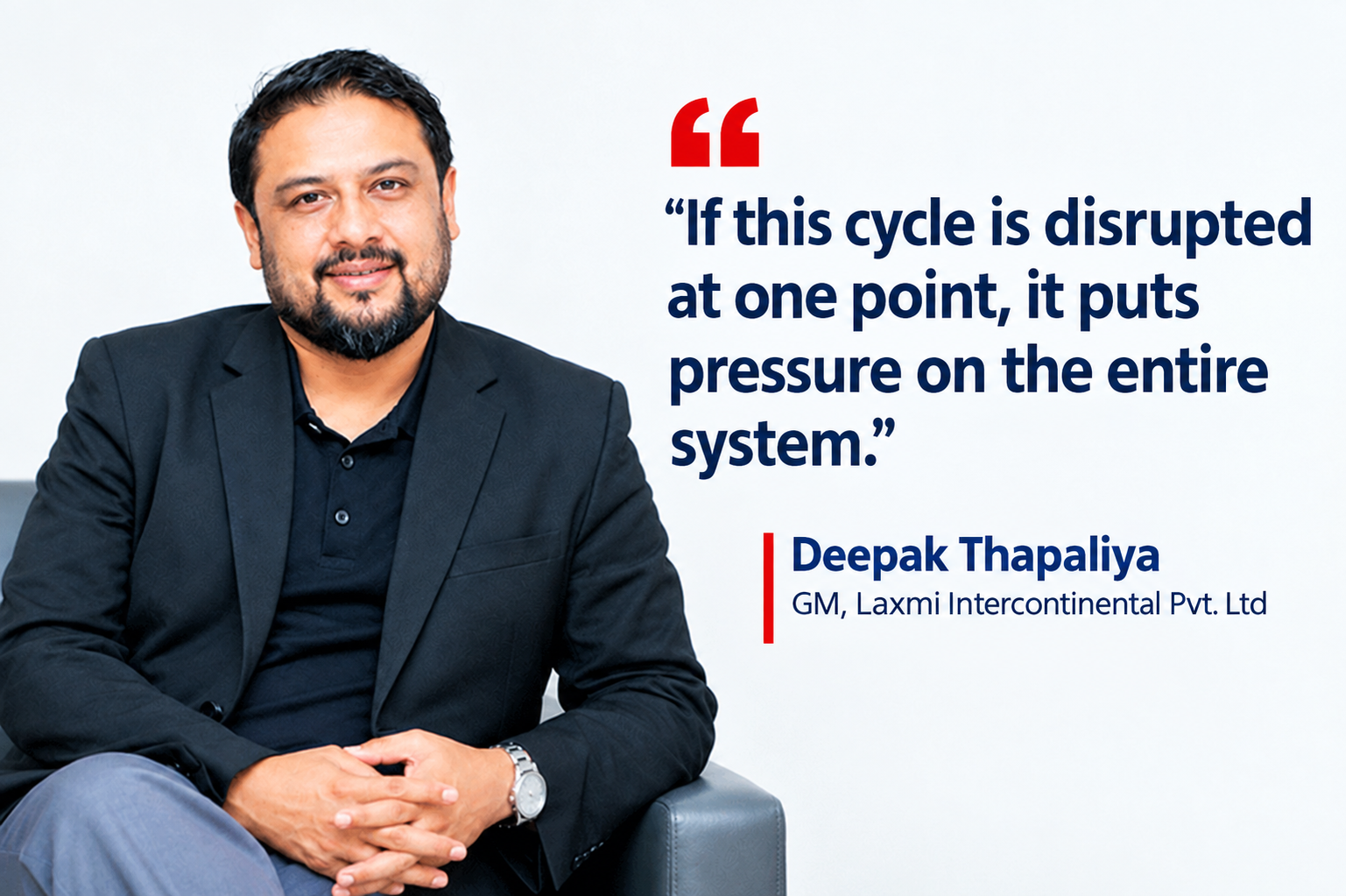
Once the goods are unloaded, the containers return for another cycle. If this cycle is disrupted at one point, it puts pressure on the entire system.
Can alternative border points or routes solve the problem?
Alternative routes are necessary. But simply announcing an alternative route does not solve the problem. A new border point needs more than a road. It requires customs infrastructure, sufficient manpower, a management system, customs yards and parking facilities.
For example, if a border point can handle only 20 to 30 vehicles a day and hundreds of containers suddenly arrive, it could create an even bigger problem.
An alternative route needs long-term preparation to operate at full capacity. It cannot be made functional overnight.
What impact will this have on the automobile sector?
The impact will not be limited to automobiles. Demand for goods rises during Dashain and Tihar. Cars, motorcycles, spare parts, food, clothing, electronics, garlic, ginger and other daily necessities all need to reach the market on time.
Goods imported for the festive season can get stuck on the way. This can push up prices, delay deliveries and create shortages. The impact on automobiles is direct.
Once a customer books a vehicle, the company needs to deliver it on time. But if the vehicle itself cannot arrive on time, delivery becomes difficult.
There is an important term in business: ‘lead time’. It refers to the time required for an ordered product to reach the market. When lead time increases, the cost of doing business also increases. Ultimately, that additional cost reaches consumers.
What should the government do for a long-term solution?
In my personal view, the government needs to make some decisions with a long-term perspective. At times, the country’s long-term supply security should take priority over immediate revenue or other interests.
Nepal is heavily dependent on one or two major trade routes. A natural disaster, political problem or road disruption can therefore affect the entire economy.
We need to work in a planned manner by understanding our resources, capacity and limitations. The Bhotekoshi flood affected hundreds of containers and new vehicles. Addressing such incidents requires a new policy approach.
Currently, businesses have to pay tax on the freight of new vehicles. This encourages them to choose the cheaper road route.
The border routes used for trade with China do not appear sustainable. If the tax on vehicle freight is removed, vehicles could instead be imported through the sea route.
Would importing vehicles through the sea route be a better option?
Bringing vehicles through the sea route costs around USD 300 to USD 500 more in freight. Because tax is also imposed on that amount, the final cost of the vehicle increases. This is why vehicles are currently being imported through road routes.
But spare parts coming from China are already transported by sea. The freight cost does not make a significant difference to their final price even after tax.
If we can bring vehicles through the sea route, we can significantly reduce the risk. The China-side border routes could then be used more easily for food supplies, religious tourism and other activities.
If the government considers this in time, it could provide long-term benefits and make Nepal’s supply chain more resilient.