KATHMANDU: The Koshi Provincial Government has introduced annual vehicle tax for EVs based on motor peak power.
The federal government recently changed the EV taxation system for imports by introducing customs duty based on the Cost, Insurance, and Freight (CIF) value. However, the provincial government has continued to calculate annual vehicle tax according to motor power.
Other provinces have not yet published their economic bills. However, they are also expected to follow a similar motor power-based system for annual EV tax.
Before May 29, EV taxes were calculated based on motor peak power at both federal and provincial levels. Finance Minister Dr. Swarnim Wagle replaced the federal system by introducing customs duty based on CIF value under five different slabs.
Under the new federal policy, EV imports now face tax rates ranging from 42.46 percent to 227.47 percent, depending on the vehicle category and value.
The federal government has authority over import-related taxes, while provinces are responsible for vehicle registration, annual tax, renewal fees, and other vehicle-related charges. This has resulted in different taxation methods at federal and provincial levels.
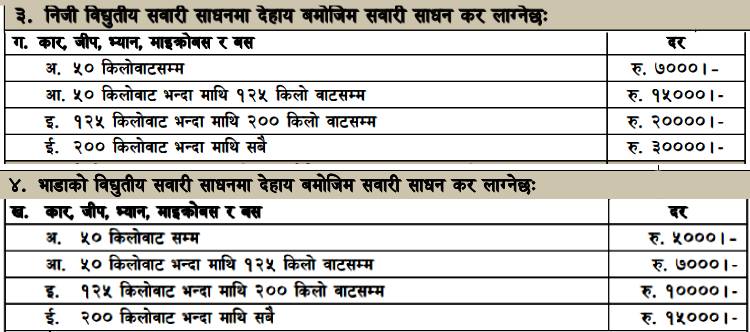
According to the Economic Bill 2026 introduced by the Koshi Provincial Government, EVs have been divided into four categories for annual tax purposes. Private cars, jeeps, vans, microbuses, and buses with motors up to 50 kW will pay an annual tax of Rs 7,000.
Vehicles with motor power above 50 kW up to 125 kW will be charged Rs 15,000 annually, while EVs above 125 kW up to 200 kW will pay Rs 20,000. Vehicles above 200 kW will have an annual tax of Rs 30,000.
For commercial four-wheelers, EVs up to 50 kW will be taxed Rs 5,000 annually. Vehicles above 50 kW up to 125 kW will pay Rs 7,000, those above 125 kW up to 200 kW will pay Rs 10,000, and EVs above 200 kW will pay Rs 15,000 annually.