KATHMANDU: The government has prepared a master plan to build 424 electric vehicle (EV) charging stations across the country.
According to the Water and Energy Commission Secretariat (WECS), the charging stations will be built along 80 national highways.
The plan aligns with the country’s Nationally Determined Contributions (NDC) 3.0, which has set a goal of increasing the share of private EVs to 95% by 2035. The construction of charging infrastructure is a key step toward achieving that target.
Jayaram Prajapati, Chief Division Engineer at the WECS, said that the master plan was developed in response to the increasing use of electric vehicles in Nepal. “EV usage in Nepal is increasing with every passing year. Since the need for charging infrastructure grows as the number of EVs expands, we have developed a national master plan to address the growing charging stations,” Prajapati told MeroAuto.
As per the master plan, the 424 charging stations will be constructed in three phases. In the first phase, 168 charging stations will be built. Similarly, 123 will be built in the second phase and 133 charging stations in the third phase. Charging stations will be built every 25 to 100 kilometers along major highways.
In the first phase, charging stations will be built in densely populated areas within the next one to three years, said Prajapati. Similarly, inter-city routes will be covered in the third phase, which is expected to take three to six years. Urban and emerging areas will be covered in the third phase with a timeline of six to 10 years.
The 424 charging stations will be constructed in three phases, with a station built every 25 to 100 kilometers along major highways.
Financing Models
The total estimated cost for building all 424 charging stations is Rs 28.88 billion.
Of this, Rs 25.57 billion will be allocated for 362 stations to be built on private land, while Rs 3.31 billion is earmarked for 62 stations on government-owned land.
The master plan has outlined multiple financing models, including direct foreign investment, loans and grants from international organizations and investments by federal and provincial governments. The Public-Private Partnership (PPP) model has also been proposed as a key approach.

The shift to EVs and renewable energy could reduce carbon dioxide emissions by up to 1,873 kilotons, according to the WECS.
The master plan has suggested combining public sector support with private sector expertise and capital. Under this model, the government can provide regulatory backing, land and seed funding, while private investors contribute technical skills, operational efficiency and additional capital. Such partnerships would reduce financial risk, expedite implementation and ensure long-term sustainability, according to Prajapati.
The master plan has identified land acquisition as one of the main obstacles to building charging infrastructure. To address this, it proposes leasing both public and private land.
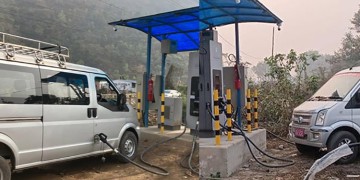
Currently, both the government and private sector are involved in developing charging stations.
Three Types of Charging Stations
The master plan has proposed installing three types of charging stations. High-capacity ones with up to 400 kW will be built for heavy vehicles, while GBT-type chargers will be installed for public vehicles. Similarly, CCS2 chargers will be used for private vehicles. Charging stations of 271 kW and 211 kW will be installed for cars, jeeps and microbuses.
The existing demand for EV charging is about 427 megawatt-hours (MWh). This is projected to increase to 8,000 MWh by 2035. The shift to EVs and renewable energy could reduce carbon dioxide emissions by up to 1,873 kilotons, according to the WECS.