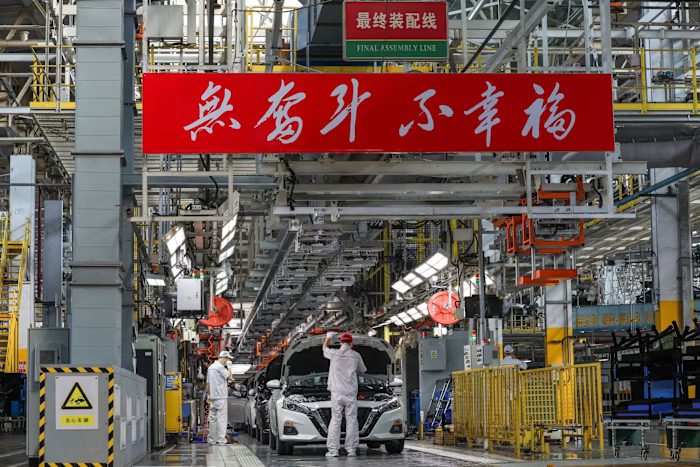
KATHMANDU: Global carmakers are quietly reshaping how and where vehicles are built. More European brands are now producing cars in China and exporting them worldwide. The shift is being driven by lower costs, strong supply chains, and fast-moving EV technology.
In the early days, Chinese factories relied on foreign designs and expertise. Today, the situation has reversed in many ways. Western automakers are now partnering with Chinese companies to build modern vehicles, especially electric ones, for global markets.
Stellantis, the parent company of Jeep, is working with Dongfeng to develop a new electric model. This vehicle will not only serve China but also markets in the Middle East and Southeast Asia. It reflects a broader trend across the industry.
Many global brands are now using China as an export base. Companies like Volkswagen, BMW, Nissan, and Hyundai are increasing shipments from Chinese plants. These factories often have unused capacity, making exports a practical solution.
China’s advantage is clear. It can produce vehicles at significantly lower costs. In some cases, EVs can be built for nearly half the cost compared to Europe. Battery prices are also much cheaper, giving China an edge in electric mobility.
Exports from China have surged in recent years. The country shipped over 7 million passenger vehicles last year, up from less than 1 million in 2020. Growth continues in 2026, with strong demand from overseas markets.
Electric vehicles are leading this expansion. Nearly half of China’s exports now include EVs and plug-in hybrids. This marks a major shift from traditional petrol cars.
Foreign brands are also adapting their strategies. Earlier, they focused on “in China for China” models. Now, many are moving to “in China for global” production. Vehicles developed in China are being sold worldwide.
Tesla and Mini have already exported China-made EVs to Europe. Nissan plans to increase exports from China to 300,000 units by 2030. These models will target markets in Asia, Latin America, and possibly Europe.
However, this trend comes with risks. European factories are already running below capacity. Increased imports from China could weaken local production and supply chains.
There are also political concerns. The US has imposed heavy tariffs on Chinese cars. Europe has introduced duties as well, but the market remains open. Policymakers worry about overdependence on Chinese technology.
To counter this, the European Union is considering new rules. These may require more local production and limit the use of Chinese components in vehicles sold in Europe.
At the same time, some European plants may collaborate with Chinese partners. This could help utilize unused capacity but may also shift more technology and expertise to China.
The global auto industry is entering a new phase. China is no longer just a low-cost manufacturing hub. It is becoming a leader in EV technology, supply chains, and innovation.
For legacy carmakers, the choice is becoming clear. They must adapt to China’s growing influence or risk falling behind in the fast-changing automotive world, writes FT.