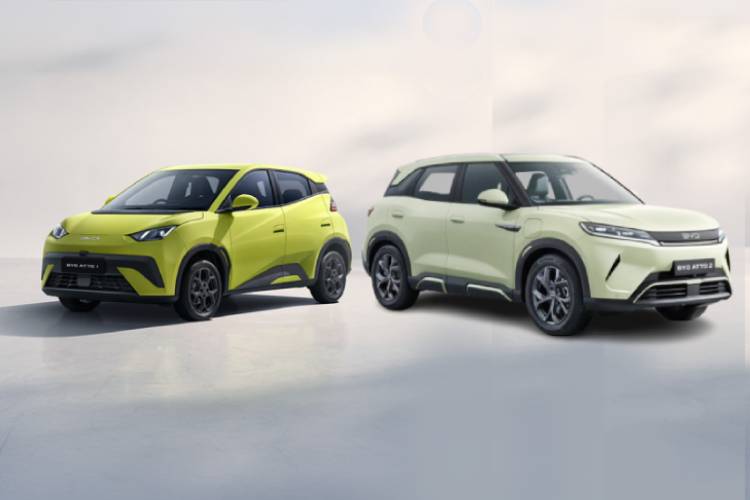
KATHMANDU: BYD’s latest electric vehicles, the Atto 1 and Atto 2, have become two of the biggest success stories in Nepal’s EV market, strengthening the Chinese automaker’s leadership in the passenger vehicle segment during the fiscal year 2025/26.
Nepal’s EV market saw a wave of new model launches over the past fiscal year as most major brands expanded their line-ups. Among them, BYD introduced three new electric vehicles. The Atto 1 and Atto 2, launched at the NAIMA Nepal Mobility Expo and the NADA Auto Show, quickly gained strength.
According to import data, BYD brought 3,563 units of the two models into Nepal during their first year in the market.
The BYD Atto 2 accounted for 2,264 units, making it the brand’s most successful new model in Nepal. Achieving such a figure in less than a year highlights the strong demand for the compact electric SUV.

The BYD Atto 1, positioned as the brand’s entry-level electric hatchback, also performed beyond expectations. Despite its compact dimensions, the model recorded imports of around 1,300 units in its first year and established itself as a popular urban EV.
The success of the two models also helped BYD’s authorized distributor, Cimex Inc., comfortably achieve its annual sales targets. They offset the declining sales of the older Atto 3 and Dolphin, while attracting a new group of EV buyers.
Industry observers believe the success of the Atto 1 and Atto 2 is largely driven by BYD’s strong reputation in Nepal. Earlier models such as the Atto 3 and Dolphin had already earned consumer trust for their battery technology, reliability and resale value. This gave buyers greater confidence when choosing BYD’s newer models.

Pricing also played a key role. The Atto 2 entered the market between the Dolphin and Atto 3 in BYD’s product lineup. It was launched at an introductory price of Rs 4.399 million, making it an attractive option for customers looking for a compact electric SUV. The segment has previously seen strong demand from models such as the Suzuki Brezza and Nissan Magnite in the ICE category.
The Atto 2 is equipped with a 51.13 kWh lithium iron phosphate (LFP) battery paired with a 100 kW electric motor producing 290 Nm of torque. BYD claims a driving range of 345 km, while its 200 mm ground clearance is considered another practical advantage for Nepali roads.
Meanwhile, the Atto 1 targets customers seeking an affordable and compact electric car for daily commuting. Its small footprint makes it suitable for urban driving, particularly in Kathmandu and other cities.
According to market analysts, the Atto 1 appealed to buyers looking for an affordable EV from a trusted brand. BYD’s established reputation gave customers greater confidence in its battery technology, after-sales service, spare parts availability and resale value.
The performance of the Atto 1 and Atto 2 shows that price was only one part of the equation. BYD’s strong brand image, practical vehicles, proven battery technology, modern features and extensive after-sales support have together driven the success of both models in Nepal.