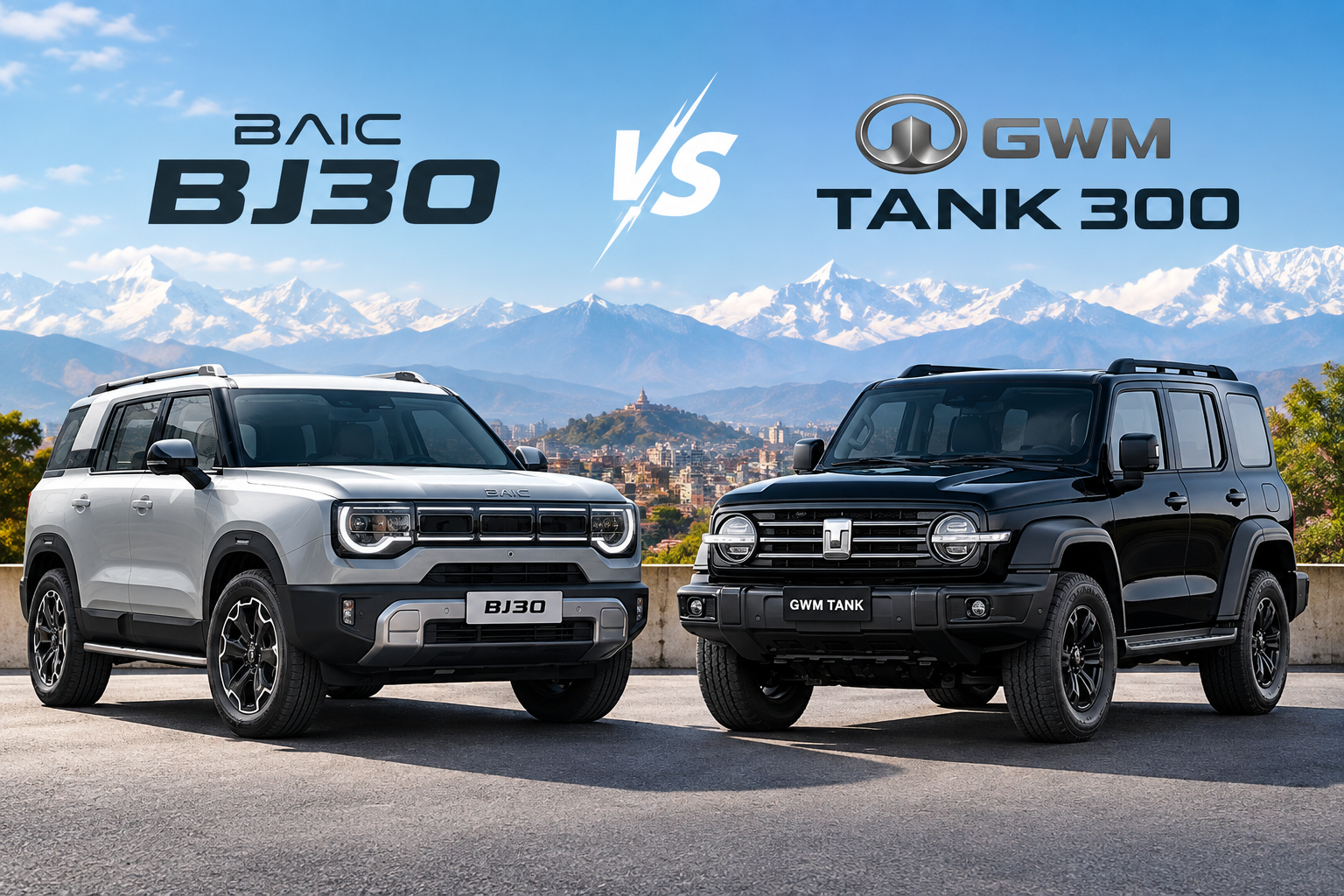
KATHMANDU: The GWM Tank 300 and BAIC BJ30e are two premium hybrid SUVs available in Nepal. Both combine a petrol engine with electric motors and come with four-wheel-drive systems.
However, the two SUVs target slightly different buyers. The Tank 300 focuses more on power and off-road capability, while the BJ30e offers more technology and features at a significantly lower price.
VG Impex, the official distributor of GWM in Nepal, sells the Tank 300 at a starting price of Rs 15.995 million. The BAIC BJ30e, distributed by Laxmi Motor Hub, is priced at Rs 11.996 million.
This creates a price difference of almost Rs 4 million, making the BJ30e the more affordable option.
Engine and power
The Tank 300 uses a 2.0-liter turbocharged petrol engine combined with an electric motor. The hybrid system produces a combined 351 PS and 648 Nm of torque. It is paired with a nine-speed hybrid transmission.
The BJ30e uses a smaller 1.5-liter petrol engine. Its petrol engine produces 155 hp and 235 Nm of torque, while electric motors fitted at the front and rear provide additional power.
The BJ30e has a combined system output of 405 PS and 685 Nm of torque, giving it higher overall power and torque figures than the Tank 300.
Tank 300 has the edge off-road
Both SUVs come with four-wheel drive, but the Tank 300 is more clearly designed for adventure and off-road driving.
It offers 224 mm of ground clearance, compared to 215 mm in the BJ30e. The Tank 300 also weighs 2,313 kg and has a larger 75-liter fuel tank, which can be useful for longer journeys.

The BJ30e weighs 1,770 kg and comes with a 51-liter fuel tank. Its lower weight could make it easier to manage in city driving and regular road conditions.
Similar size, but BJ30e gets a longer wheelbase
The Tank 300 measures 4,760 mm long, 1,930 mm wide and 1,903 mm tall. It has a wheelbase of 2,750 mm.
The BJ30e is 4,730 mm long, 1,910 mm wide and 1,790 mm tall. However, it has a longer 2,820 mm wheelbase, which could offer more space for rear-seat passengers.
BJ30e offers more cabin technology
The Tank 300’s main strengths are its power, rugged design and off-road ability. The BJ30e, meanwhile, puts greater emphasis on technology and a modern cabin.
It gets a 10.25-inch digital instrument display and a 14.6-inch infotainment screen. Other features include a Snapdragon 8155 chipset, wireless charging, dual-zone climate control, an air purifier and ADAS.

Its driver assistance features include adaptive cruise control, lane-keeping assist, blind-spot monitoring and emergency braking.
The Tank 300 comes with safety features such as seven airbags, a 360-degree camera, hill-hold assist and an electronic parking brake with auto hold.
Price is the biggest difference
The biggest difference between the two SUVs is their price. Buyers need to spend almost Rs 4 million more for the Tank 300.
The Tank 300 could be the better choice for those looking for a larger engine, strong off-road ability, higher ground clearance and a larger fuel tank. Its rugged build also makes it more suitable for adventure-focused buyers.
The BJ30e, on the other hand, offers four-wheel drive, more power on paper, a modern cabin, large screens and advanced driver assistance features at a lower price.
The choice, therefore, depends on what buyers want from their SUV. The Tank 300 is more focused on ruggedness and off-road capability, while the BJ30e offers a technology-focused package with strong performance at a more accessible price.
(Note: VG Impex has said it will soon bring the plug-in hybrid version of the Tank 300 to Nepal. The upcoming model is expected to be priced higher than the current version.)