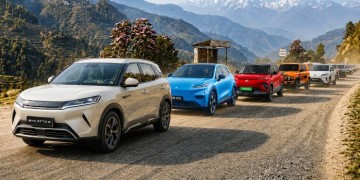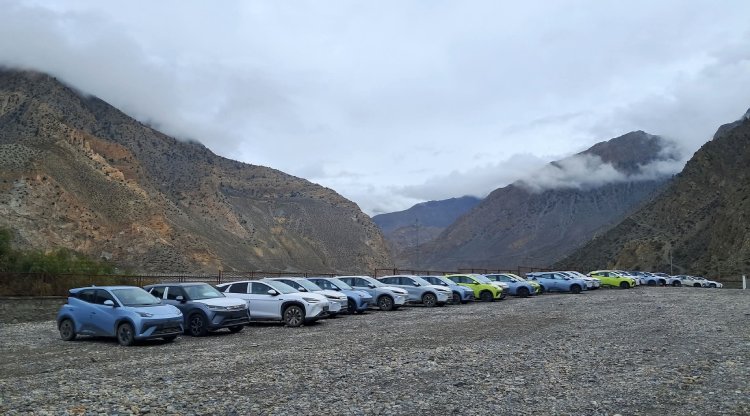
KATHMANDU: The government is set to levy a ‘Clean Infrastructure Investment Fee’ even on electric vehicles (EVs) imported before the budget announcement.
Through the Economic Act 2026(2083), introduced to implement the budget for the upcoming fiscal year 2026/27(2083/84), the government has provided that this tax will also apply to EVs imported prior to the budget.
However, this ‘Clean Infrastructure Investment Fee’ will not have to be paid for all EVs imported before the budget. It will only apply to electric vehicles that have been imported from abroad but are yet to be registered at the transport management offices.
Consequently, automobile dealers will now have to pay the Clean Infrastructure Investment Fee even for EV cars that have been imported from abroad but have not yet been registered at the transport offices.
Through the budget, Finance Minister Swarnim Wagle has scrapped the existing excise duty on electric vehicles and introduced a new tax under the title of ‘Clean Infrastructure Investment Fee’.
Generally, changes made to tax rates through the budget apply to conditions after the budget announcement. However, Finance Minister Wagle has imposed this tax on imported goods even before the budget. For newly importing vehicles, this tax will be collected by the customs office at the customs point.
Section 11 of the Economic Act contains provisions regarding the Clean Infrastructure Investment Fee. Sub-section 1 states that the Clean Infrastructure Investment Fee will be levied and collected as per Schedule 3 on electric passenger and cargo vehicles imported or manufactured within Nepal.
Similarly, Sub-section 2 provides for the taxation of electric vehicles imported before the commencement of this Act but yet to be registered.
“The fee pursuant to sub-section (1) shall be collected by the customs office at the customs point for electric passenger and cargo vehicles imported after the commencement of this Act. In the case of passenger and cargo vehicles imported before the commencement of this Act but yet to be registered, and those manufactured domestically and brought into consumption, the office registering such vehicles shall collect the fee from the manufacturer based on their cost price at the time of registration,” states Section 11, Sub-section 2 of the Economic Act.
The transport office must deposit the collection of this new tax into the Federal Consolidated Fund at the time of registration. Likewise, Sub-section 4 makes it mandatory to send a monthly report of the fee collected pursuant to Sub-section 2 to the Ministry of Finance, Government of Nepal.
Currently, there is a provision where new vehicles are registered at the Transport Management Offices under the provincial governments. The registration fees collected by those offices also go to the Provincial Consolidated Fund. However, the Economic Act has made a clear provision ensuring that the amount collected from the Clean Infrastructure Investment Fee will go directly into the Federal Government’s fund.
According to the Economic Act, the Clean Infrastructure Investment Fee ranges from a minimum of 2.5% to a maximum of 130%.
Under this new fee structure, a tax of 2.5% is levied on cars valued up to 2 million, which increases to 20% for vehicles valued between 2 million and 3 million.
For cars in the Rs 3 million to Rs 4 million range, the fee is set at 35%, while those valued between Rs 4 million and Rs 5 million face a 90% tax. Finally, any electric vehicle valued above Rs 5 million is subject to the maximum rate of 130%.
This new tax will be levied on the value derived by adding the customs duty to the transaction (CIF) value determined for the purpose of levying customs duty.