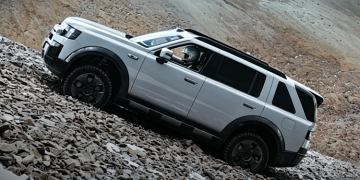
KATHMANDU: Two new entry-level electric vehicles (EVs) have entered the country’s compact SUV market.
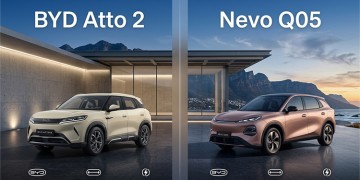
BYD Atto 2 and Dongfeng Nammi Vigo are direct competitors in terms of battery size, driving range and body dimensions. The Atto 2 is available in a single variant and costs Rs 4.399 million, while the Vigo is available in tow variants. While the Vigo E2 is priced at Rs 3.899 million, the E2+ can be driven home for Rs 4.199 million.
Both models were formally unveiled at the 2025 Auto Show which concluded in Kathmandu last week.
Below is the comparison of these two models:
Dimensions
The Nammi Vigo measures 4,306 mm in length, 1,868 mm in width and 1,645 mm in height, and has a 2,775 mm wheelbase and 185 mm ground clearance. It features 17-inch alloy wheels and offers a spacious 500-liter boot.
The Atto 2 is slightly longer at 4,310 mm, but slightly narrower at 1,830 mm and taller at 1,675 mm. It has a shorter wheelbase of 2,620 mm. It also comes with 17-inch wheels, while ground clearance has not been disclosed. Atto 2 has a smaller boot capacity of 400 liters.

Cabin Features
The Atto 2 offers a 12.8-inch touchscreen infotainment system, an 8.8-inch digital instrument cluster, flat-bottom four-spoke steering, and features such as wireless Apple CarPlay and Android Auto, 50W wireless charging pad, powered and ventilated front seats, leatherette upholstery, voice assistant, panoramic sunroof, electric tailgate and an 8-speaker audio system.
The Vigo, on the other hand, features a minimalist cabin design. It matches the Atto 2’s 12.8-inch touchscreen and 8.8-inch instrument cluster. The oval-shaped steering wheel has a gear knob positioned behind it. Other highlights in the car include heated, ventilated and massage front seats, wireless charging pad, hidden center console compartment, soft-touch interior materials, ambient lighting, panoramic sunroof and a 6-speaker audio system.
Battery, Motor and Range
Vigo is equipped with a 99 kW front-wheel drive motor, while the Atto 2 has a slightly more powerful 100 kW motor. Both SUVs are expected to deliver comparable torque and acceleration.
The Atto 2 uses a 51.13 kWh LFP battery offering 340 km (WLTP) range. It supports 7 kW AC and 82 kW DC fast charging and includes vehicle-to-load (V2L) functionality.
The Vigo is available in two battery variants: 44.94 kWh and 51.87 kWh. It supports 7 kW AC and 60 kW DC charging. The E2 and E2+ variants offer a WLTP driving range of 300 km and 350 km, respectively.

Safety Features
Both SUVs are equipped with strong safety suites. The Vigo offers DJI-powered Level 2 ADAS, multiple airbags and features like ABS, EBD, electronic stability control, 360-degree camera and hill assist.
Similarly, the Atto 2 includes six airbags and has features like ABS, ESC, EPB, 360-degree surround-view camera, BYD digital key, hill assist and Level 2 advanced driver assistance, among others.
Exterior Design
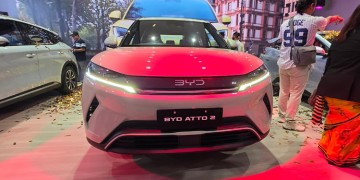
The Atto 2 features sleek LED headlights, slim DRLs, glossy black accents and a full-width LED taillight with a unique infinity-ring design.
The Vigo embraces a futuristic and dynamic look, with C-shaped LED DRLs, a closed-off grille and pixel matrix LED taillamps. High shoulder line, roof rails and 17-inch alloys enhance the car’s profile.
Conclusion
The Vigo is built on Dongfeng’s Quantum Architecture 3, while the Atto 2 is based on BYD’s advanced e-Platform 3.0 with cell-to-body technology. Both platforms support a new generation of electric mobility.
With features closely matched, consumer preferences and pricing will determine which model takes the lead in the market.