POKHARA: The journey from Kathmandu to Pokhara is about 200 km. Yet, I reached Pokhara only after covering 220 km in an iCaur V23.
The car was 99% charged when I left from Uttar Dhoka, Kathmandu. There were four passengers, including me, with a combined weight of about 340 kg. Along with two small suitcases, a large camera bag, and two handbags, the total load was around 380 kg.
There are now several ways to go to Pokhara. Instead of the usual Nagdhunga road or the new Sitapaila–Dharke road, I chose the Tokha–Chhahare–Galchhi route. It was raining in Kathmandu, and we left the valley at 8 am.
We had planned to film the car during the trip. The first thing I noticed while moving through Shivpuri National Park was its regeneration. From Gurje Bhanjyang to Chhahare, it gained 5% battery back over a 12 km stretch, which was impressive.

Because of filming, turning and navigating slippery roads, we added an extra 20 km. That’s why the total distance came to 220 km. Since this was a test drive, I wasn’t worried about range. My focus was on comfort, handling and performance.
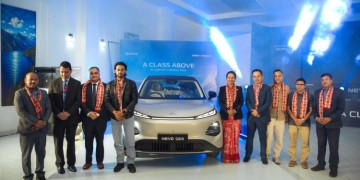
Two companions—SPG Automobile General Manager Gyanendra Chand and Dealer Head Ashish Dahal—were experienced drivers. I let them take the wheel on some stretches, while I sat in the back seat to observe passenger comfort.
As a Passenger
The back seat fits three people. However, the middle seat has no headrest, only a lowered section with a roof-mounted seatbelt. Safety isn’t compromised, but comfort could be better.
There is no dedicated AC vent at the back. This may mean that those sitting at the back might not get the cool air from the AC. However, the cabin cools quickly. The AC is capable of keeping the cabin cool from Chitwan to Pokhara. The airflow in the back is good.
Legroom and headroom are generous, even with bags on the floor. Handles are well-placed for rough roads. The seats are supportive and the suspension absorbs potholes smoothly, ensuring little discomfort for passengers.

Driving Experience
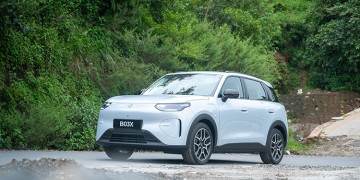
The road from Galchhi to Muglin can hardly be called a highway. Luckily, there were no traffic jams, but there were potholes, mud and waterlogged areas. Here, the vehicle’s 210 mm ground clearance proved invaluable.
The full-circle steering, voice command button and gear knob behind the wheel are convenient. Braking is solid and the 19-inch alloy wheels handled the rough patches with ease.
Its 100 kW rear-wheel-drive motor delivers smooth acceleration. Combined with the vehicle’s weight and off-road setup, it performed impressively. The 15.4-inch floating display replaces a separate instrument cluster, showing all information in three sections.
The car remains easy to control at high speeds and driver-assist sensors add confidence. From the outside, it looks like an off-road SUV, but the interior feels refined, almost luxurious.
Driving modes include Eco, Comfort, Sport and Sleepy for off-road conditions. I mostly used Comfort mode, which balanced efficiency and performance.

Range
The iCaur V23 uses a 60 kWh CATL battery. On paper, at 15 kWh per 100 km, it should deliver about 400 km. CLTC has also certified 401 km.
In practice, after driving 220 km, 69 % of the charge was consumed. This means a full charge would realistically cover around 319 km—still a respectable figure for its size and weight.
Verdict
With its retro design and capable build, the V23 feels ready for rough terrain. From the outside, it carries the stance of a rugged SUV, but inside it offers the comfort of a luxury model. It blends both worlds in one package.
SPG Automobile has announced the top variant will cost under Rs 4.7 million. At this price, the V23 is eye-catching and could carve out its own space in the market. Sales, however, will begin only in November, so festival buyers may have to wait a little longer.