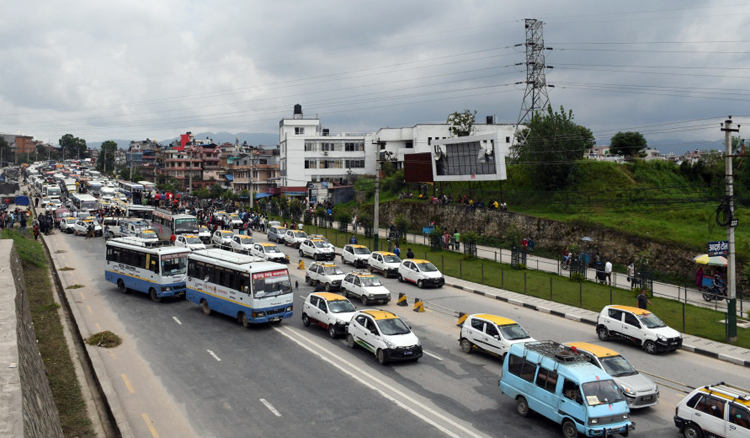
KATHMANDU: The government has decided to adopt a policy of phasing out diesel vehicles and allowing only electric vehicles for new registration, as part of its effort to convert public transportation to electric.
Minister for Infrastructure Development Sunil Lamsal informed that the government is preparing policies and laws to make EVs mandatory for public transport.
During discussions with transport entrepreneurs, he clarified that the government had halted diesel vehicle registration specifically in preparation for converting public transport into EVs. He made it clear that the government does not favor diesel vehicles, stating that only EVs will be registered as public vehicles from now on.
He said the government’s plan is to fully convert taxis, short-route buses, and long-route buses nationwide into EVs, adding that preparations for the necessary policies and laws are underway.
“We will no longer operate vehicles with diesel engines. This is our firm stance. From now on, whatever vehicles pass through customs and enter Nepal, long-route, short-route, taxis all of them are meant to go electric,” he said.
He said that currently operating old diesel vehicles will be gradually scrapped and converted to EVs. To encourage entrepreneurs in this process, he said schemes such as concessional loans, subsidies, or customs exemptions could be offered. He also requested entrepreneurs to bring forward a clear framework for this.
“For all the diesel vehicles that exist right now, we need to give them scrap value and, through concessional loans, subsidies, and various customs exemptions to the owners, make this feasible and viable. You draft the bill. The government is ready to pass it,” he said.
According to him, the registration of black number plates was halted so that entrepreneurs would not face losses in the future. The government has halted registration of public vehicles since May 21. However, while registration for cargo vehicles has been reopened, there is no clarity yet on when passenger vehicle registration will resume. He argued that since fluctuations in diesel prices have repeatedly hurt entrepreneurs, the shift towards EVs is inevitable in the future.
“That is exactly why we have currently stopped the black number plate registration. Right now, many people would end up buying diesel engines. And later, when we make electric vehicles compulsory and mandatory, they would be the ones to suffer losses. It is with this understanding that we made this decision,” he said.
He said the government is working on a new transport policy and law aimed at organizing the public transportation sector according to the BRT model and international standards.
He also informed that, in coordination with the Asian Development Bank and the ministry, work on public transport management has already begun in the first phase in Pokhara, to be followed by Kathmandu and Lumbini.
The use of electric vehicles in Nepal is growing rapidly. While the share of EVs among private cars has already crossed 70 percent, the use of EVs in large public vehicles remains very low. This is why the government is now moving to adopt a policy that embraces only electric vehicles for public transport.