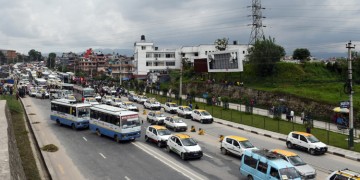
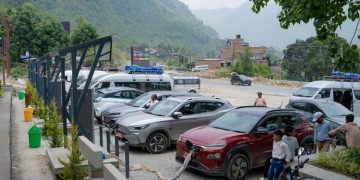
KATHMANDU: Hundreds and thousands of people are moving out of the Kathmandu Valley for Dashain celebrations.
According to the traffic police, 500,000 people have already left the capital using public transport, while thousands more are traveling in private cars and motorcycles, in just a week.
Electric vehicles (EVs) have gained huge popularity in Nepal in recent years. People are using EVs for long-distance trips from Kathmandu to Jhapa in the east or Kanchanpur in the west. EVs are also now reaching remote hilly and Himalayan districts.
But as EV sales surge, the demand for charging has outpaced supply. While charging is usually manageable at other times of the year, past experiences show hours-long waits are inevitable during peak travel seasons.
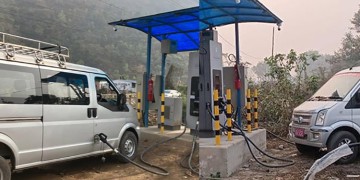
To address this, both the public and private sectors are expanding their charging network. According to the Nepal Electricity Authority (NEA), over 1,550 charging stations have already been installed across the country. These charging stations are installed by NEA itself, as well as automobile dealers and entrepreneurs.
Despite the rapid expansion of charging infrastructure, charging is not fully reliable in some areas due to voltage fluctuations.
Automobile dealers have unveiled plans to add hundreds more.

Availability of Charging Stations
Around four dozen EV brands are currently being sold in Nepal. Most leading companies have set up their own charging networks.
Cimex Inc, which represents BYD in Nepal, has installed 55 DC fast chargers of 30 kW across major cities and highways, according to Sushil Tandukar, the service manager at Cimex Inc.
Similarly, SPG Automobiles, the authorized distributor of Omoda, ZEEKR and Leapmotor, has set up 32 fast chargers across the country. It has also installed a 40 kW unit at Tsarang in Upper Mustang (3,453m) — the highest charging point in the country so far — to facilitate movement of EVs in Upper Mustang, according to Gyanendra Chand, general manager of the company.
MAW Vriddhi, which sells brands like Seres, Neta, Deepal and Foton, has built the largest CCS2 network with 134 DC fast chargers. Eighteen of these stations feature double-gun 60 kW units, while the remaining have 40 kW chargers.
Similarly, Laxmi Group, which represents brands like Hyundai, Kaiyi and BMW in Nepal, has installed 10 DC fast chargers at key locations. It has also opened Re-Lax charging units at five locations, which also have repair facilities, according to Laxmi Group’s General Manager Deepak Thapaliya.
Sipradi Trading, the authorized distributor for Tata Motors—one of the earliest to link EV sales with its own network—operates 34 DC fast chargers along highways and in major cities. It also has a wide AC charging base.
CG Motors operates the country’s biggest charging network with about 300 units, including 248 GBT and 24 CCS2 fast chargers.
NEA has installed 61 chargers. Similarly, private firms and even some local governments have built charging stations.
Despite the rapid expansion of charging infrastructure, charging is not fully reliable in some areas due to voltage fluctuations.