KATHMANDU: The Kathmandu-Terai/Madhesh Expressway, one of Nepal’s National Pride Projects, has achieved an overall physical progress of 43.66 percent. Initiated in 2017 with a six-year completion target, the project has completed less than half of the total work in eight years.
According to Nepal Army Spokesperson (Brigadier General) Rajaram Basnet, the project’s financial progress has reached 44.89 percent, with a total expenditure of Rs 82.17 billion so far. Of this, Rs 1.65 billion has been spent on land acquisition, Rs 823.7 million paid to contractors, and Rs 981 million provided in advance to the Nepal Electricity Authority.

The 70.977-km expressway is divided into 13 packages, of which 12 are under construction. The Package No. 11 (Khokana–Dukuchhap section) has not yet been contracted due to ongoing land disputes at the entry point in Khokana. The Ministry of Defense is coordinating efforts to resolve the issue.
Among the 12 active packages, progress varies significantly. Only two packages have exceeded 50 percent completion, while most remain below 20 percent.
Package-wise Progress:
- Package 1 (24.8–29.1 km): 34.68%
- Package 2 (29.1–33.7 km): 64.03%
- Package 3 (48.2–55.8 km): 47.01%
- Package 4 (55.8–63.6 km): 41.30%
- Package 5 (63.6–70.9 km): 51.58%
- Package 6 (38.1–48.2 km): 19.16%
- Package 7 (33.7–38.1 km): 17.39%
- Package 8A (6.5–11.1 km): 4.50%
- Package 8B (11.1–16.1 km): 6.27%
- Package 9A (16.1–18 km): 2.34%
- Package 9B (18–20.7 km): 2.25%
- Package 10 (20.7–24.8 km): 12.77%
- Package 11 (0–6.5 km): Yet to be awarded
Despite being one of the country’s largest ongoing projects with top government priority, overall progress remains slow. To meet the revised completion target by mid-April 2026, the Army would need to complete the remaining 56 percent of work within just 18 months a highly challenging goal.
The project’s estimated cost has also increased from Rs 175 billion to Rs 211.93 billion due to time extensions and design changes.
Road paving and structure works
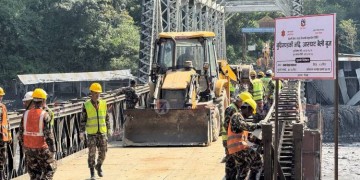
According to Basnet, 5 km of service lane has been blacktopped under Package 3 in Rajdamah, Makwanpur. Similarly, 9.3 km of road base layers (sub-base) have been laid in Packages 3 and 5, particularly in the Nijgadh area. Construction of an animal underpass, toll plazas, and interchanges is ongoing in Bara district.
Slope protection, box culverts, optical fiber ducts, and electrification duct installations are also in progress across several sections.
Tunnel construction
Seven tunnels with a total length of 10.979 km are under construction. The Lendanda (1,622 m) and Dhedre (1,690 m) tunnels have already achieved breakthroughs, and secondary lining works are ongoing.

The Mahadevsthan tunnel, the longest at 3,355 m, has achieved about 65 percent excavation progress, with 61–68 percent completed on both sides. The Army aims to complete its breakthrough within the current fiscal year.
Tunnels at Chandram Bhir (2,250 m), Devichaur (1,000 m), Sisautar (390 m), and Mauribhir (594 m) are also under various stages of excavation or portal preparation.
Bridge construction
Out of 89 planned bridges (total length 12.885 km), 85 contracts have been awarded. Foundations for 51 bridges and substructures for 26 bridges have been completed, while six bridges have finished superstructure construction.

Land dispute halts work at starting point
Although construction continues in other areas, the starting point at Khokana remains unresolved due to local opposition. Residents have demanded that the entry point be shifted about 5 km south to Dukuchhap.
Out of the 897.97 hectare of land required for the project, 245.1 hectare of private land have already been acquired. The Ministry of Defense is coordinating with concerned bodies, and the Cabinet is expected to make a policy-level decision soon to resolve the issue.
The project was handed over to the Nepal Army on May 4, 2017, and formally inaugurated by then Prime Minister Pushpa Kamal Dahal ‘Prachanda’ on May 28, 2017 in Nijgadh, Bara.
The expressway stretches from Khokana in Lalitpur to Nijgadh in Bara, passing through Kathmandu and Makwanpur districts. Once complete, it will reduce travel time between Kathmandu and the Tarai by up to four hours and is expected to save over Rs 50 billion annually in transportation costs.