KATHMANDU : Construction of the Kathmandu-Tarai/Madhesh Fast Track, one of Nepal’s National Pride Projects, has reached 48.72% physical progress as of mid-July 2026. The project has also achieved 50.63% financial progress, including mobilization costs, according to the Nepal Army.
The 70.977-km expressway was handed over to the Nepal Army for implementation by a Cabinet decision on May 4, 2017. Construction contracts were awarded from 2021.
The project has been divided into 13 construction packages. Contracts have been awarded for 12 packages, while work on the Khokana-Dukuchhap (Package 11) section is yet to begin.
According to Nepal Army spokesperson Brigadier General Rajaram Basnet, land acquisition issues and a pending decision on traffic management in the Khokana section have delayed the package. Preparations are underway to start work once these issues are resolved.
Construction of bridges, tunnels, roads, interchanges, toll plazas, slope protection, box culverts, optical fiber ducts and electrification ducts is progressing simultaneously in the contracted sections.
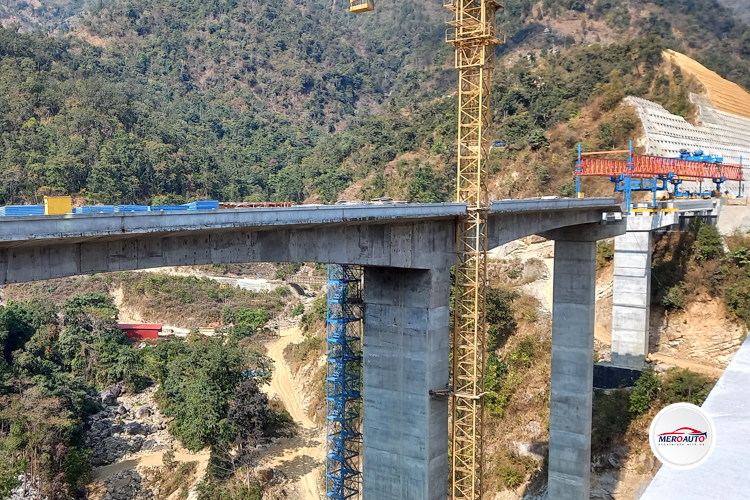
16 bridges completed, asphalt work begins
The Fast Track includes 89 bridges with a combined length of 12.885 km. Contracts have been awarded for 85 bridges, while four bridges in the disputed Khokana section are yet to be tendered.
Of the contracted bridges, 16 have been completed. Foundation work has been completed on 57 bridges, while substructure work has been completed on 38 bridges. Ten bridges were completed during the last fiscal year alone.
Road paving has also started. Around 1 km of the main carriageway has been asphalted in Package 3 (Rajdamar, Makwanpur). Another 7 km of service roads has also been paved in the same section.

Sub-base has been laid on 11.02 km of road in Packages 3 and 5, while base course work has been completed on 5.8 km.
The expressway will be 25 meters wide in the hilly section and 27 meters wide in the Terai.
An animal underpass has been completed in Nijgadh, Bara. Construction of toll plazas and interchanges is also underway. Rest areas will be built at Budune, while interchanges and toll plazas are planned at Khokana, Budune and Nijgadh.
Two tunnels broke through
The Fast Track includes seven tunnels with a combined length of 11.21 km.
So far, the 1,622-meter Lendanda Tunnel and the 1,690-meter Dhedre Tunnel have achieved breakthrough. Secondary lining work has been completed at Lendanda, while Dhedre is in its final lining stage.
Excavation of the 3,355-meter Mahadevtar Tunnel, the longest on the project, is 89% complete. Lining work is also progressing.
Tunnel excavation is also underway at Chandrambhir, Devichaur, Sisautar and Mauribhir.
A total of 55,887 trees have been cut for the project. In return, 705,512 saplings have been planted. Of these, 151,000 saplings have been raised and handed over to the concerned authorities.
The project has spent Rs. 92.68 billion, including mobilization costs, so far. Its estimated total cost stands at Rs. 211.93 billion, making it Nepal’s largest ongoing infrastructure project by budget.
Starting point yet to be finalized
While construction continues across most sections, the project’s starting point remains unresolved.
The current DPR identifies Khokana as the starting point. However, compensation disputes and local opposition have delayed work in the area.
On February 17, 2026, the government directed officials to move ahead with an alternative alignment.

Earlier, in March 2024, a technical team from Pulchowk Engineering Campus and the Department of Roads submitted three alternative proposals. These included starting the expressway from Dukuchhap, Bungamati or a new alignment near Sikali Ghat. More recently, Chobhar has also emerged as another possible starting point.
However, no final decision has been made.
The Nepal Army said a revised DPR with multiple alignment options has already been submitted to the government and is awaiting Cabinet approval. Tendering for the Khokana section will begin after the revised DPR is approved.
Deadline likely to be extended again
The project is unlikely to meet its current completion deadline of mid-April 2027. More than half of the construction work is still pending.
The original completion target was August 12, 2021, when the project was first handed over to the Nepal Army. The deadline was later extended to mid-December 2024, and again to mid-April 2027.
Although the Army has not commented on another extension, stakeholders believe the project may require an additional three years to finish.
Once completed, the Kathmandu-Tarai/Madhesh Fast Track is expected to reduce travel time between Kathmandu and the Terai to around one hour. It is also projected to save more than Rs. 50 billion annually through lower transport and fuel costs.