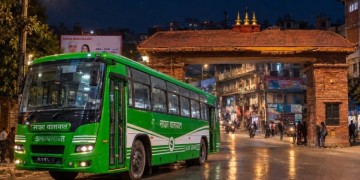
KATHMANDU: The Department of Transport Management (DoTM) has decided to conduct a study to determine the age limit of public vehicles.
The existing age limit for public transport vehicles is 20 years. With this fresh study, the DoTM aims to assess whether this limit is appropriate, scientific and practical in the current context.
In 2017, the federal government introduced a rule preventing the renewal of public vehicles running on fossil fuel once they reach 20 years of age. Similarly, the Bagmati Province Government has introduced and implemented a policy of scrapping public vehicles older than 20 years.
Although transport entrepreneurs challenged both these decisions in court, the Patan High Court and the Supreme Court ruled in favor of the government’s plan to phase out 20-year-old public transport vehicles.
Despite this, transport entrepreneurs have continued to oppose the policy, terming it unscientific and impractical. Rather than supporting the government’s efforts to remove old vehicles, they have resisted scrapping vehicles that have reached their age limit of 20 years.
Because of this, the DoTM has initiated a new study on the age limit of public vehicles. It has formed a committee under Shreekant Yadav, who oversees vehicle testing, cross-border transport management and vehicle standards at the DoTM, to conduct the study.
Director Yadav said the need for a new study was felt because of continued opposition to the 20-year age limit by the transport entrepreneurs. “The committee will examine international practices, environmental impacts and scientific justifications regarding the phasing out of older vehicles,” Yadav told MeroAuto. “Entrepreneurs claim that the 20-year limit is inappropriate. This study will find out whether their concerns are valid or merely self-serving,” Yadav told MeroAuto.
Currently, there is no age limit for private vehicles in Nepal. However, owners are required to pay an additional 5% on vehicle renewal tax on vehicles older than 15 years.
“Focus On Fitness, Not Age”
Transport entrepreneurs argue that setting a vehicle’s lifespan based solely on age is misguided.
Beganath Gautam, General Secretary of the Federation of Nepal National Transport Entrepreneurs, said the 20-year rule is neither scientific nor fair. He believes vehicle roadworthiness should be judged based on fitness, not age.
“At present, public vehicles can’t be operated after 20 years. However, this policy is unscientific and impractical,” he told MeroAuto. “The number of years doesn’t really matter; what matters is the vehicle’s mechanical condition. If a vehicle passes technical inspections, it should be allowed on the road, regardless of age. The focus should be on fitness, not age.”
He added that not all new vehicles are roadworthy, and not all old vehicles are unfit. “Sometimes even new vehicles fail due to manufacturing defects, while a 20-year-old vehicle can be technically sound,” he said.
Gautam also criticized the government for targeting only public transport with the age cap. He pointed out that although the Supreme Court had ordered uniform standards for all types of vehicles more than a year ago, the government has yet to implement this.

No Scrappage Policy Yet
Many countries around the world have implemented vehicle scrappage policies to retire old vehicles. While the specific age limit varies by country, most mandate scrapping vehicles between 15 to 20 years of age.
Nepal, however, has not yet introduced a formal scrappage policy. Although the 2017 rule prohibits renewing public vehicles older than 20 years and requires their deregistration, no broader scrappage framework exists.
There is also no age limit for private vehicles.
Gandaki Has Age Limit for Private Vehicles
With the shift to federalism, the responsibility for managing and regulating the transport sector now falls under the jurisdiction of provincial governments. Accordingly, provinces have enacted their own transport acts.
All provinces have set a 20-year age limit for public vehicles powered by fossil fuel. Of the seven provincial governments in the country, only Gandaki Province has imposed an age limit for private vehicles, capping their lifespan at 25 years.
While Bagmati, Gandaki and Karnali have a policy to retire electric vehicles (EVs) after 30 years of operation, other provinces have no specific policy for EVs.